Author: Marwa Masoudy

  • ???? How to apply for a TfL PHV Driver Licence (PCO) in 2026 – Full Guide

    ???? How to apply for a TfL PHV Driver Licence (PCO) in 2026 – Full Guide

    If you want to drive as a minicab or app-based driver in London (for example with Uber, Bolt, or any licensed operator), you must obtain your PHV driver licensed from Transport for London (TfL).

    This guide explains the application process for 2026:

    • What you need before you apply
    • What documents and codes TfL will ask for
    • What the assessments are
    • How long the process can take
    • What the costs are

    Important: Submitting an application does not guarantee a licence. TfL may request extra information during the process.


    ✅ Step 0: Check you meet the basic eligibility

    Before you start, make sure you meet TfL’s core requirements:

    • You are 21 or older.
    • You have held a full driving licence for at least 3 years.
    • You have the right to live and work in the UK.
    • You are considered medically fit (DVLA Group 2 standard).
    • You are considered of good character (Enhanced DBS checks).

    If any of your identity documents have different spellings or missing middle names, fix that first. TfL expects names to match across documents.


    ???? Step 1: Create a TfL online account and start the application

    Create your TfL TPH account here for making applications.


    ???? Step 2: Gather your documents

    Typical documents and proofs TfL may ask for include:

    • Passport or other accepted identity document
    • Driving licence
    • Proof of address (for example: bank statement, council tax bill, utility bill)
    • Right to work proof (if required)
    • Photograph that meets TfL’s guidance

    Overseas convictions checks / Certificate of Good Conduct (CoGC)

    If you have lived outside the UK for one or more continuous periods of 3 months or more in the last 10 years (including extended vacations), TfL may require:

    • A Living Abroad Details form (TPH/205), and
    • A Certificate of Good Conduct (CoGC) from every relevant country

    Official TfL guidance


    ????️ Step 3: Enhanced DBS check + DBS Update Service (very important)

    To be licensed, you must complete an Enhanced DBS check through TfL’s authorised provider.

    You must also sign up to the DBS Update Service.

    • TfL will not grant a licence unless you are registered.
    • Once licensed, you must keep the subscription active.

    For full instructions, see: How to apply for DBS check and DBS Update Service (TfL PHV Application)


    ???? Step 4: DVLA Group 2 medical (fit to drive)

    You must meet the DVLA Group 2 medical standard.

    In most cases, you will need a medical examination with a medical professional who can access your full medical history.

    You will need to have this form completed by a doctor.


    ???? Step 5: HMRC tax check / tax obligations (don’t leave this late)

    Tax rules depend on your situation.

    • First-time applicants (never held a PHV driver licence before): you won’t need to provide a tax check. You only need to confirm you understand your tax responsibilities.
    • If you currently hold, or previously held (within the last 12 months), a private hire driver licence with any licensing authority (not just TfL): you must complete a tax check and provide the tax check code.

    A tax check code is time-limited (expires after 120 days), so only generate it when you are ready to submit.

    For more information, see HMRC tax check guidance.


    ???? Step 6: Pay the TfL fees

    TfL publishes the fee table and warns that there is no fast-track service.

    A typical example total often comes out around £538 (excluding the medical cost), depending on which assessments apply and your medical fee.

    Service Cost
    Enhanced DBS check £52 (online) / £54 (paper)
    DBS Update Service £16 per year*
    Licence application fee £138
    Grant of licence fee £205
    Post Office® Check and Send £7.15
    Speaking and listening assessment (if applicable) £40
    Topographical assessment (if applicable) £40
    SERU assessment £40
    Medical Fee set by the examining doctor (your GP)
    Example total £538 (excluding cost of medical)

    *You must keep your DBS Update Service subscription active to be granted a licence.

    Note: You should also budget for the cost of training and study materials too.


    ???? Step 7: Wait for the invitation and then book your assessments

    After you submit your application, TfL will review it. If everything is in order, TfL will invite you to book your assessments. The initial review can take 2 weeks to 3 months to receive your invitation.

    In most cases, you will book the assessments through your TfL portal and they will be scheduled on the same day.


    ???? Step 8: Prepare for, and pass, the assessments

    TfL expects applicants to pass mandatory assessments before licensing.

    For most new applicants, these include:

    ???? Preparing for the assessments

    • Seek one-to-one training if you need further help

    ⏳ Step 9: Final review (the waiting period after you pass)

    After passing the assessments, TfL carries out final checks before issuing the licence.

    This final review is where many applicants feel “stuck” because the application is largely complete but TfL still needs to finish compliance checks.


    ????️ Typical timeline (realistic expectations)

    Timelines vary, but a common experience is:

    • Initial review and invitation to book assessments can take weeks to a few months.
    • Preparing for assessments takes 2 to 6 weeks
    • Results for assessments often come within a few weeks.
    • Final licence after passing can takes 6 months on average but can take longer, depending on TfL workload and whether any documents need clarification.

    Overall, many applicants should plan for a long process and avoid leaving renewals or career plans to the last minute.


    ⚠️ Common mistakes that delay PHV applications

    1. Documents don’t match (name order, spelling, missing middle names)
    2. Missing DBS Update Service registration
    3. Uploading unclear photos/scans
    4. Medical form issues (wrong doctor, missing sections, not stamped/dated)
    5. Waiting too long to prepare for assessments
    6. Generating an HMRC tax check code too early (it can expire)

    ???? Need help with the application?

    If you want support completing the TfL application correctly (documents, codes, DBS process, uploading, and submission), enquire about our PHV application service.


    ???? Important TfL contact details

    If you need to contact TfL about taxi & private hire licensing, these are commonly used contact options:


    ❓ Quick FAQs

    What is the total wait time from start to finish?

    12 to 18 months on average

    Is there a fast-track option?

    No. TfL warns that any third party selling a “fast-track” is fraudulent.

    Do I need to retake the assessments every year?

    No, once you pass your assessments you don’t need to retake them. Unless your license expires and you fail to apply for a renewal before the expiry date.


    ???? Next steps

    Before you get started, it is a good idea to understand what your expected earnings and costs might be.
    You can estimate your earnings and costs depending on the hours and type of work you plan to to do, using our calculator: London Uber Driver Earnings Calculator
  • TfL B1 Speaking & Listening Test (English Requirement) – 2026 Full Guide

    TfL B1 Speaking & Listening Test (English Requirement) – 2026 Full Guide

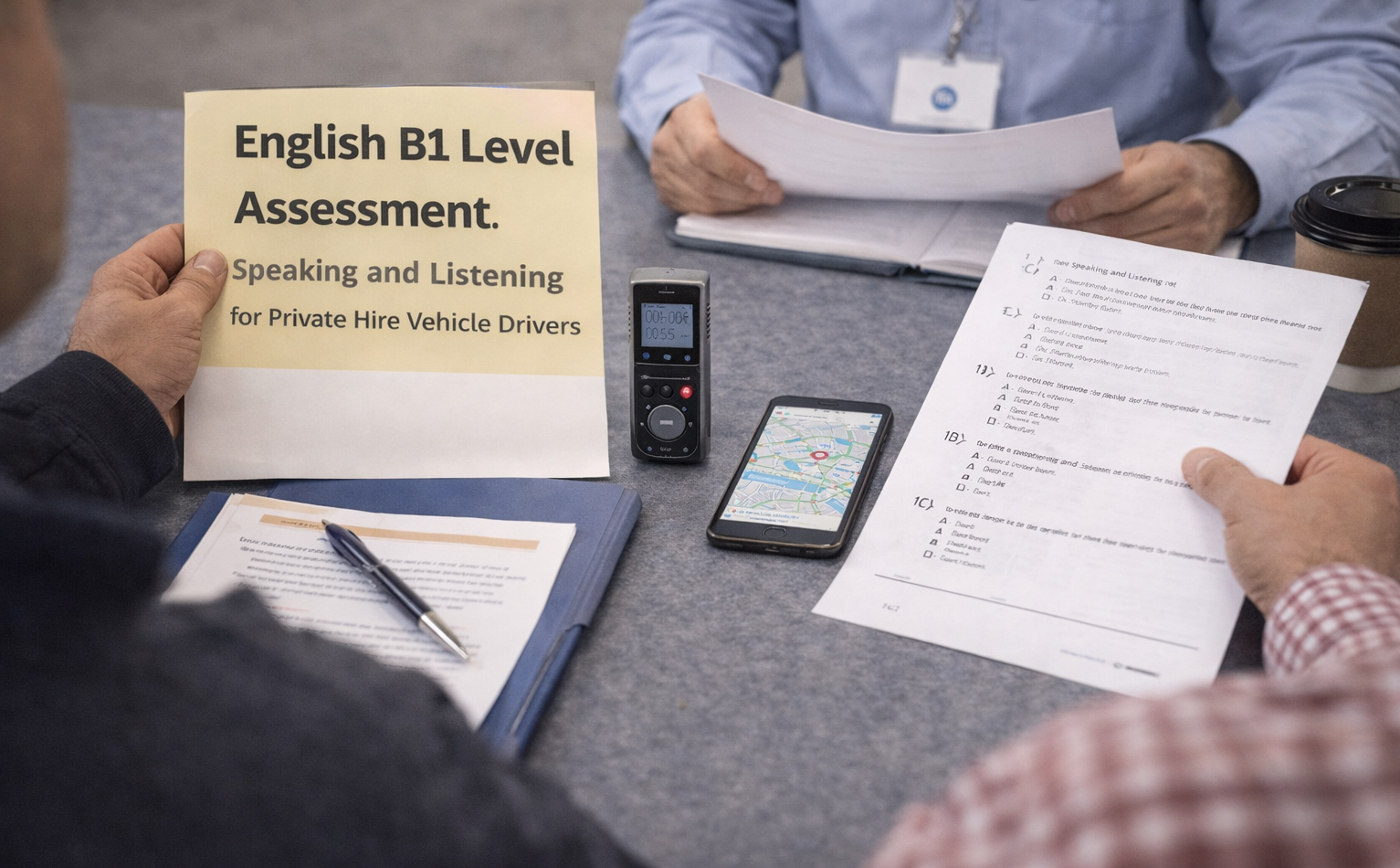
    The TfL B1 Speaking & Listening test (also known as the English Language test, or simply B1) is a basic English communication assessment required by TfL. It checks that PHV drivers can understand passengers, speak clearly, and respond appropriately in everyday travel situations.

    It is mandatory for all PHV applicants and TfL no longer accepts qualification-based exemptions (even if you have a degree or GCSE/college qualifications).

    This guide summarises the format, timings, and question types using a real-style practice paper, plus the key rules PHV applicants usually ask about.


    Test length and structure

    • Total time is usually 11–13 minutes.
    • The test is split into 4 parts.
    • You will speak with an examiner (the interlocutor).

    ???? Goal: Speak clearly, answer the question directly, and keep your answers long enough to show your English (but not so long that you lose track of the question).

    Part 1: Personal questions (about 1.5–2.5 minutes)

    This part is a short conversation about you.

    You can expect:

    • Identity checks and simple admin questions (for example, spelling your name)
    • Everyday questions about your life and preferences

    Example topic from the sample paper: sports and physical activities

    • Do you enjoy sports or physical activities? Why or why not?
    • What is your favourite way to stay active?
    • How often do you exercise or play sports?
    • Do you prefer indoor or outdoor activities?

    Part 2: Role-play situations (about 3 minutes)

    You will do short role-plays (usually two situations, sometimes three if time allows).

    What this tests:

    • Starting a conversation politely
    • Asking for help
    • Explaining a problem
    • Responding appropriately

    Examples from the sample paper:

    • Doctor check-up: the interlocutor starts and you respond naturally.
    • Clothing shop: you start by asking for help, then respond to questions.

    Part 3: Discussion (about 3 minutes)

    You will discuss a topic with the interlocutor. This is more like a structured conversation.

    Example topic from the sample paper: healthy living

    • What do you do to stay healthy?
    • Is it easy or difficult to live a healthy lifestyle? Why?
    • What changes would you like to make to improve your health?
    • Is it important to include physical activities in schools for young students? Why or why not?

    Part 4A: Listening, note-taking, and questions (about 3 minutes)

    The interlocutor reads a short text twice.

    You should:

    • Listen carefully
    • Take notes
    • Answer questions based on what you heard

    Example listening topic from the sample paper: drinking water

    Typical question styles:

    • A direct question about the main idea (Why is it important?)
    • A detail question (How many glasses each day?)
    • A benefits question (What are two benefits?)
    • A simple multiple-choice comprehension question (for example, the tone: serious, informative, casual)

    Part 4B: 1.5-minute talk + follow-up questions (about 2.5–3 minutes total)

    You will speak on your own for about 1.5 minutes.

    You get 30 seconds to prepare notes.

    Example speaking task from the sample paper:

    • Talk about: A healthy habit you have

    Then the interlocutor asks follow-up questions, such as:

    • How did you start this habit and why?
    • How has it helped you in daily life?
    • Would you recommend it to others? Why?
    • How long does it take to adopt a new habit?

    Simple tips to score well

    • Answer in full sentences. Avoid one-word replies.
    • Explain “why”. It immediately makes your answer stronger.
    • Use linking words like “because”, “for example”, “also”, “however”.
    • In Part 4A, write keywords only (not full sentences) so you can keep listening.
    • In Part 4B, keep a clear structure: start, explain, give an example, finish.

    Key FAQs (quick answers)

    • Where is the test held? At TfL assessment centres in West Kensington and Greenwich (the same locations used for SERU and Topographical assessments).
    • How much does it cost? Typically £36 for the first attempt, and £16 for a resit.
    • When do you need to pass? You must pass before SERU and before your PHV licence can be issued.
    • Can you work (Uber/Bolt) before passing? No. You cannot work until B1 is passed, SERU is passed, and your licence is issued.
    • What happens if you fail? You must rebook and resit. You cannot take SERU or receive your PHV licence until you pass.
    • When will TfL invite you to book? After your documents are approved, TfL invites you in the online portal.
    • Do you have to write anything? No, but you can make notes.
    • Can you skip questions and come back? No.
    • Do you get partial marks? Yes, you can get marks for partially correct spoken answers.
    • How is the test conducted? It is run at the TfL Assessment Centre, typically as a video call with an examiner.

    Want 1-to-1 help or a mock test?

    If you want to prepare faster or build confidence, you can contact us to book:

    • 1-to-1 Speaking & Listening lessons
    • A full mock test (real format and timings)

    Call: 020 3965 7202

    Website: www.serupractice.com

  • How to apply for DBS check and DBS Update Service (TfL PHV Application)

    How to apply for DBS check and DBS Update Service (TfL PHV Application)

    Enhanced DBS + DBS Update Service (TfL PHV) — quick steps

    1) Apply for the Enhanced DBS (TfL authorised provider)

    Use the TfL authorised provider registration link:

    Register on KnowYourPeople (KYP)

    Parameter Value
    Organization ID ORG-2333DWY8
    accessCode tphcrb

    2) Complete DBS application form

    • Complete the online application.
    • Your name must match across your documents and your TfL account.

    3) Verify your identity at the Post Office

    • Print the DBS Post Office verification summary.
    • Take the verification summary and your documents to the Post Office.
    • Complete verification at the Post Office.

    4) Get your DBS application reference

    Check your email for the DBS reference number (10-digit number often beginning with E0). You can use this when registering for the DBS Update Service. To subscribe using your application reference number, your application form must be received by DBS within 28 days.

    5) Join the DBS Update Service (required)

    Sign up here:

    • Cost: £16 per year.
    • You must keep the subscription active (do not let it lapse).

    Note: If you use the reference number to register, you do not have to wait for the DBS certificate to arrive, but you must use it within 28 days of your application.

    6) Receive your DBS certificate

    • Keep the physical certificate safe.

    If you forgot to register your Update Service, you can do it within 30 days of receiving your certificate, using your certificate number instead of your application reference number.

    This is the number located at the top right-hand side of your certificate (the “certificate number”). To subscribe using your certificate number, your certificate must have been issued within the last 30 days.

    7) Upload your DBS certificate photo/scan

    Upload your certificate online to your TfL PHV driver application

    8) Ongoing requirement after you subscribe

    TfL checks that you are registered to the DBS Update Service every 6 months. Ensure your subscription is active by paying your subscription fee annually.


    Can you use an existing DBS?

    Yes — an existing DBS from another PHV licence or application may be accepted if it meets all TfL requirements.

    Your DBS must:

    • Be an Enhanced DBS
    • Include checks against both the Adults’ and Children’s Barred Lists
    • Include:
      • Convictions, cautions, reprimands and warnings
      • Section 142 Education Act information
      • Any other relevant information disclosed at Chief Police Officer(s) discretion
    • Be for the position:
      “Other Workforce – Taxi/Private Hire driver”
    • Be issued within the last 4 months
    • Include all current and previous names, including aliases or shortened names
    • Be applied for through:
      • TfL’s authorised DBS provider, or
      • Another Taxi & Private Hire licensing authority

    If using an existing DBS, you should already be subscribed to the DBS Update Service, or register within 30 days of receiving the certificate.

    Common reasons applications get delayed

    1. Using the wrong DBS provider
    2. Incorrect or unclear ID uploads
    3. Names not matching across documents
    4. Not joining the DBS Update Service in time
    5. DBS Update Service subscription expiring

  • (PHV) SERU Assessment 2026 – Full Guide

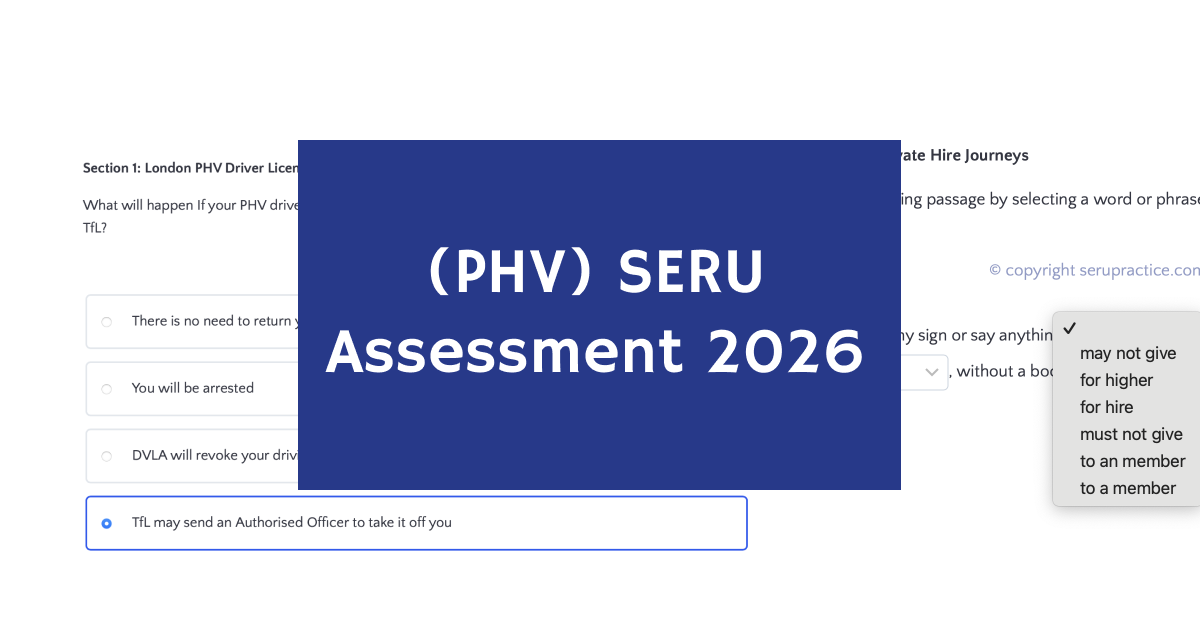
    (PHV) SERU Assessment 2026 – Full Guide

    SERU stands for Safety, Equality & Regulatory Understanding. It is a TfL assessment that checks you understand the rules, safety responsibilities, and equality and safeguarding duties expected of TfL private hire (PHV/PCO) drivers.

    Test length and structure

    • 60 minutes total time
    • 36 questions in total
    • Computer-based assessment
    • Open book (handbook provided at the test centre)

    What is the SERU assessment?

    • A computer-based knowledge assessment for London PHV drivers.
    • It is based on the official TfL PHV Driver’s Handbook.
    • The assessment is open book. You are given a copy of the handbook at the test centre.

    How to pass (simple, effective plan)

    1. Read the official handbook properly
      • SERU is based directly on it, and you will use it in the test (open book).
    2. Practise in the official format
      • Do timed mock tests so you learn how to find answers fast in the handbook.
      • If you want a full step-by-step prep program, use the TfL SERU Online Course.
    3. Focus on fill-in-the-blank accuracy
      • Unanswered blanks are marked incorrect, so always attempt every blank.
      • If you’ve failed before, your fastest improvement usually comes from heavy fill-in-the-blank practice.
      • Use the SERU Fill in the Blanks Questions pack for targeted practice.
    4. Do full mocks under exam timing
      • 60 minutes, no distractions.
      • Review mistakes and re-check the relevant handbook sections.
      • Use the official-format TfL SERU Mock Test Pack to practise in the closest style to the real exam.

    Who has to take it?

    • All new PHV licence applicants (you cannot get a PHV licence without passing SERU).
    • Existing PHV drivers may also need to pass SERU as part of licensing requirements (especially if you were licensed before SERU was introduced).

    When do you need to take it?

    • For new applicants: after you submit your PHV application and before TfL can issue your licence.
    • For existing drivers: you must pass before TfL renew your licence.

    Question types

    • 22 Multiple Choice questions (MCQs)
    • 12 Fill-in-the-blank (dropdown format)
    • 2 Reading & Understanding (short passages with questions)

    Pass mark

    • 60%
    • That means at least 23 out of 36 correct.

    Attempts

    • New applicants: up to 3 attempts.
    • Existing drivers: unlimited attempts (as long as you attend).

    Costs

    • First attempt: £40
    • Resit: £30

    Quick FAQ

    • Can I skip and return to questions? Yes.
    • Do you get partial marks on fill-in-the-blanks? Yes, partial credit is awarded for partially correct answers.
    • Can I use pen and paper? No.

  • Taxi (Black Cab) SERU Assessment 2026 – Full Guide

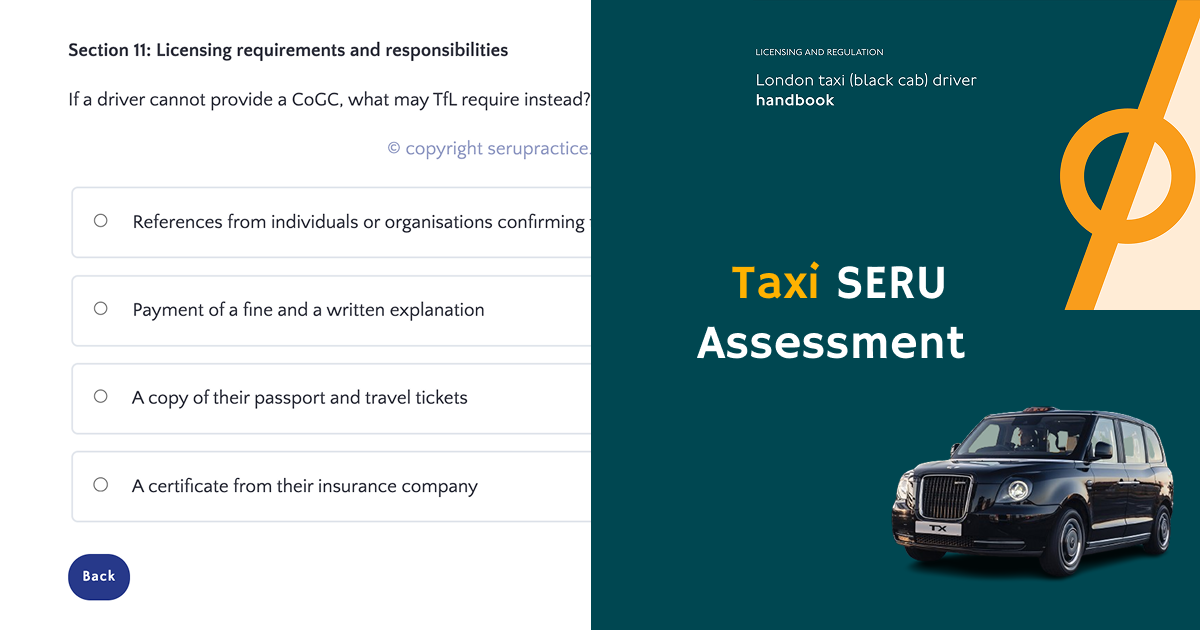
    Taxi (Black Cab) SERU Assessment 2026 – Full Guide

    This guide is for the TfL Taxi (Black Cab) SERU Assessment (not PHV SERU).

    Test length and structure

    • Total time is 60 minutes.
    • Computer based (no pen or paper)
    • 36 questions

    ???? Goal: Plan routes on map software, identify locations and navigate maps using directions.

    Everything you need to know about the Taxi (Black Cab) SERU Assessment (2026)

    The Taxi SERU assessment is TfL’s Safety, Equality and Regulatory Understanding test for London taxi (black cab) drivers. It checks that drivers understand day-to-day responsibilities around safety, equality, passenger support, safeguarding, and the key rules set out in the Taxi Driver Handbook.

    This guide focuses on what the assessment is, who it applies to, how the day works, and how to prepare efficiently.

    What is the Taxi (Black Cab) SERU assessment?

    • A TfL assessment that checks your understanding of safety, equality and safeguarding duties, regulations, and driver responsibilities.
    • It is based on the official Taxi Driver Handbook. Use this as your main study material: TfL Taxi Driver Handbook (latest version)

    Who needs to take Taxi SERU, and when?

    Taxi SERU applies to two main groups:

    • New applicants applying for a taxi driver licence on or after 1 October 2025. You normally sit the assessment before you can be licensed (often around Stage 4 or 5).
    • Existing licence holders whose licence expires on or after 1 October 2025. You must pass before TfL can renew your licence.

    If you submit your renewal before your licence expires, TfL may allow you to continue working for up to 12 months while you complete and pass SERU (depending on the rules for your specific case).

    Where the assessment happens, and what to bring

    The assessment is taken at the TfL driver assessment centre, 14 Pier Walk, London SE10 0ES (near North Greenwich).

    Bring:

    • Original photo ID
    • A payment card

    Format, timing, and pass mark

    Taxi SERU is completed on a computer and lasts 60 minutes. There are 36 questions, and the pass mark is 60%.

    The questions include:

    • 22 multiple-choice
    • 12 fill-in-the-blank
    • 2 reading and understanding questions

    You can skip questions, flag them, and return later. There is no negative marking, so it is worth making an educated guess if you are stuck.

    Is it open book?

    Yes. Taxi SERU is open book, and TfL provides a copy of the handbook at the assessment centre (you cannot bring your own copy).

    Because you only have 60 minutes for 36 questions, speed matters. Many candidates find it challenging not because the content is complicated, but because it is easy to lose time searching through the handbook.

    Booking, fees, retakes, and results

    TfL will usually contact you as your licence expiry approaches. If you want to book earlier, you can email assessments@tph.tfl.gov.uk.

    Fees are typically:

    • £40 for the first attempt
    • £30 per retest

    If you do not pass, you can usually retake the assessment (fees apply). Results are commonly issued within 15 days, but it can take longer.

    Safeguarding requirement (do this first)

    Before you sit Taxi SERU, you must complete the Safeguarding Awareness Course. This is an online video course that you complete at home, and it is not supervised.

    Link: TfL Safeguarding

    Taxi SERU vs PHV SERU (they are not the same)

    Taxi SERU is for taxi drivers and is not the same as the SERU used for private hire (PHV) licensing. The two assessments use different handbooks and different content structures. Taxi SERU is typically based on 12 sections, while the PHV SERU handbook is typically structured into 10 sections. PHV licensing also includes a separate B1 Speaking and Listening English test.

    How to revise and pass (without wasting time)

    Most people pass by doing two things consistently:

    1. Read the Taxi Driver Handbook so you know where information is located.
    2. Practise timed mocks in the same style as the real test until you are comfortably scoring 70%+.

    Use our official-format mock pack here: TfL Taxi (Black Cab) SERU Mock Test Pack

    A common revision timeline is around 2 weeks, but it depends on English reading speed and computer confidence.

    English level and accessibility support

    You will need good English reading skills to work quickly under time pressure.

    If you have a disability or learning difficulty, TfL may be able to provide reasonable adjustments if you submit evidence. Email assessments@tph.tfl.gov.uk to request support.

  • How to Pass TfL Topographical Skills Assessment 2026 – Full Guide

    How to Pass TfL Topographical Skills Assessment 2026 – Full Guide

    Test length and structure

    • Total time is 70 minutes.
    • Computer based
    • 24 questions

    ???? Goal: Plan routes on map software, identify locations and navigate maps using directions.

    The TfL Topographical Skills Assessment (often called TOPO) is a map-reading and route-planning test for PHV applicants. It checks whether a driver can read on-screen maps properly, find locations quickly, and plan legal, sensible routes across London.

    How to prepare (and pass first time)

    The fastest way to improve is to practise exactly what the test asks you to do: route planning rules, timed MCQs, and On-screen maps reading.

    A structured option is the TfL Topographical Course Package, which is a self-study course covering all question types, including route planning practice with video solutions, On-screen map reading question practice, and full mock tests.

    During the exam, remember you are allowed to skip questions and return to them later, so do not get stuck too long on one question early on.

    One-to-one Topographical training (route planning help)

    For students who need extra support (for example, basic English, failed once, or need help using the computer), there is one-to-one Topographical training.

    The one-to-one lessons focus on route planning only. They are delivered 100% online in a live classroom with screen sharing, so the instructor can see the screen and guide the student in real time. Lessons are typically one hour each, and many students need around 7 hours total depending on level and progress.

    These lessons do not include self-practice access outside of lesson time, so students who want extra practice usually combine lessons with a self-study course.


    Question types in details (and what they test)

    You will typically see three areas:

    Route planning tasks: These check whether you can plan a route between two places using correct rules. Route planning is the most important part of the exam, because it is worth the majority of the marks.

    Compass and direction questions: These test basic direction skills (North, South, East, West) and how junctions and roads relate to each other.

    On-Screen Map question: These test require you to find information on the map by reading the map.

    Test format (what happens on the day)

    The assessment is a practical, computer-based test. You will use a computer at the test centre and you will also be given an A-Z Master Atlas of Greater London during the exam. It is open book, but sat-nav is not allowed because TfL wants to test real map skills. Pen and paper are not allowed, but you can request a magnifying glass if needed.

    The test lasts 70 minutes and contains 24 questions. These are a mix of route planning tasks and multiple choice questions based on compass directions and on-screen map reading.


    Who needs to take the Topographical test?

    Most new PHV driver applicants need to pass the Topographical test, unless they qualify for an exemption (for example, already being a licensed London Taxi driver).

    When do you take it?

    You usually take the Topographical test after submitting your PHV licence application and before TfL can issue your licence. You book it through your TfL portal once you are invited.

    Where is the test held?

    The Topographical assessment is held at TfL-approved test centres, and candidates book through their TfL portal account.

    Pass mark (and how the marks work)

    You need 60% to pass. Not all questions are worth the same.

    Route planning carries most of the marks (around 66% of the total). Compass questions are typically worth more than A-Z multiple choice questions, so the best strategy is to treat route planning as the priority and avoid losing easy marks on compass questions.

    Attempts and costs

    Your first attempt typically costs £40 and a resit costs £30. Candidates usually have two attempts. If both are failed, TfL may require the applicant to restart the licence application process.

  • How much does a London Uber driver earn? – Calculator

    How much does a London Uber driver earn? – Calculator

    Are you thinking of becoming an Uber driver in London? Have you wondered if it will be worth your time? Now you can get an estimate of what your earnings may look like based exactly on your circumstances—such as the hours you’ll work or the car you’ll drive. It will also give you an idea of the costs.

    What you’ll find out

    The calculator shows you:

    • How much you could earn per week and per hour
    • What your vehicle will cost (including insurance)
    • Your actual take-home pay after all expenses

    All estimates are based on real data from 200 London drivers in 2025, so you’re getting realistic figures, not guesswork.

    How it works

    Simply tell the calculator:

    • How many hours per week you plan to work (20–90 hours)
    • When you’ll be working (early mornings, afternoons, evenings, late nights—you can pick multiple times)
    • Whether you’ll work weekends
    • What type of car you’ll drive (Normal like Prius or Kia Niro, Executive like Mercedes E Class, or 7 Seater like Hyundai Santa Fe)

    The calculator then shows you exactly what you could earn based on your specific situation.

    What you need to know

    Hourly earnings are based on online time—meaning the time you’re logged into the apps, not just when you’re actively driving. This includes time waiting for rides, time driving between pickups, and quieter periods. This gives you a realistic picture of what you’ll actually earn when you’re online with Uber, Bolt, Wheely, or Exec.

    The data comes from 200 London drivers in 2025 and reflects current rates, TfL requirements, and real-world costs across all these platforms.

    Try it now

    Use the calculator to see your potential earnings. It takes less than a minute, and you’ll get a clear breakdown of what you could earn based on your exact circumstances.


    Open the Uber Earnings Calculator

    Estimates are based on 2025 data from 200 London drivers. Actual earnings may vary based on individual circumstances.