This is the latest version of the handbook for pedicab drivers which can be used as a guide for SERU Exam preparation.
This handbook is subject to changes and modifications based on the rules and regulations of TfL.
This is the latest version of the handbook for pedicab drivers which can be used as a guide for SERU Exam preparation.
This handbook is subject to changes and modifications based on the rules and regulations of TfL.
SERU stands for Safety, Equality & Regulatory Understanding. This TfL assessment verifies that you comprehend the regulations, safety obligations, and equality and safeguarding responsibilities required of TfL Pedicab drivers.
—————————————————————————————————-
You can download the latest pedicab driver handbook from here:
https://serupractice.modishwebsolutions.com/pedicab-driver-handbook-latest-version-download/
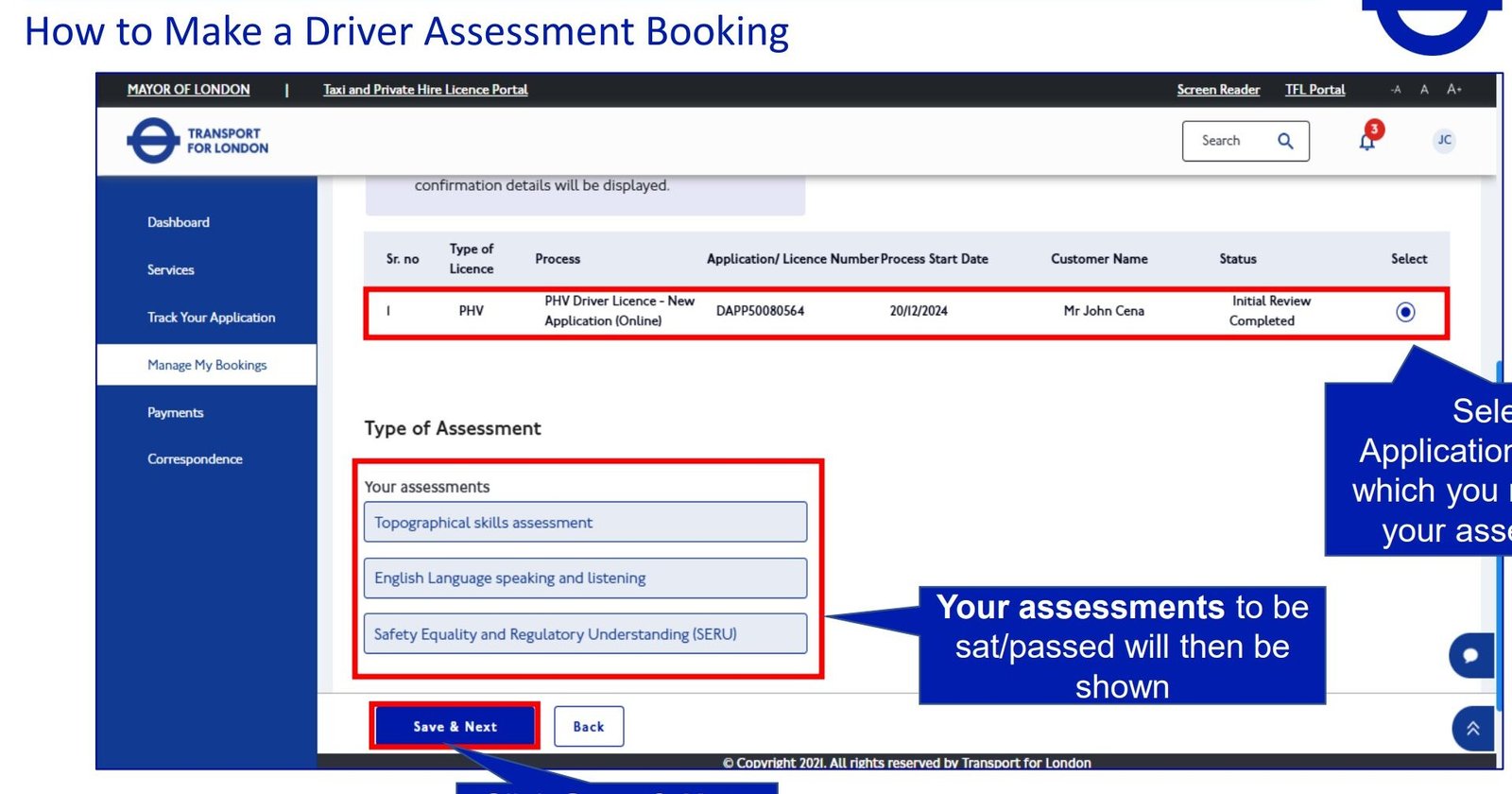
As of March 2025, TfL PHV drivers and new applicants can book their SERU and Topographical assessments online.
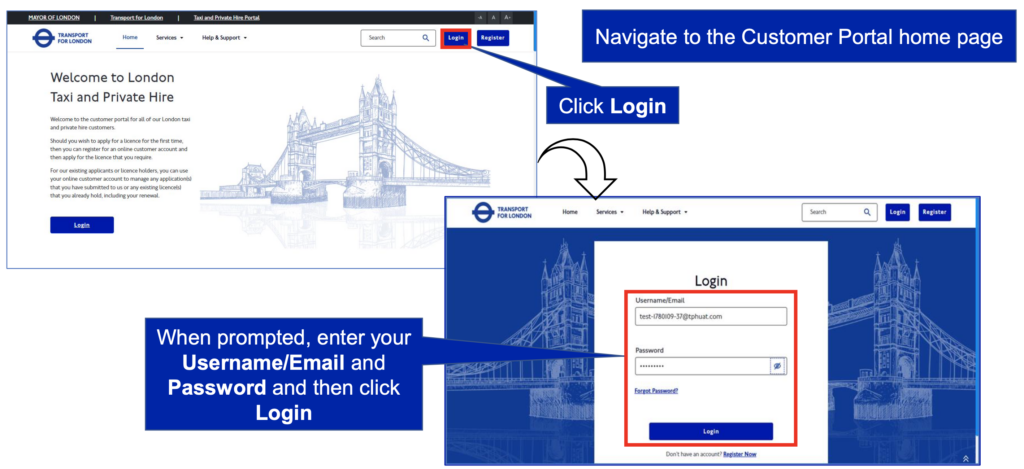
To book your assessments, you will need to login to the new portal.
You can use your existing / old TfL PHV account details to login.
Once logged in, follow the instructions below to book your assessments.
Step 1. Login (click button on the top right)
Step 2. Select “Manage My Bookings” (from left menu)
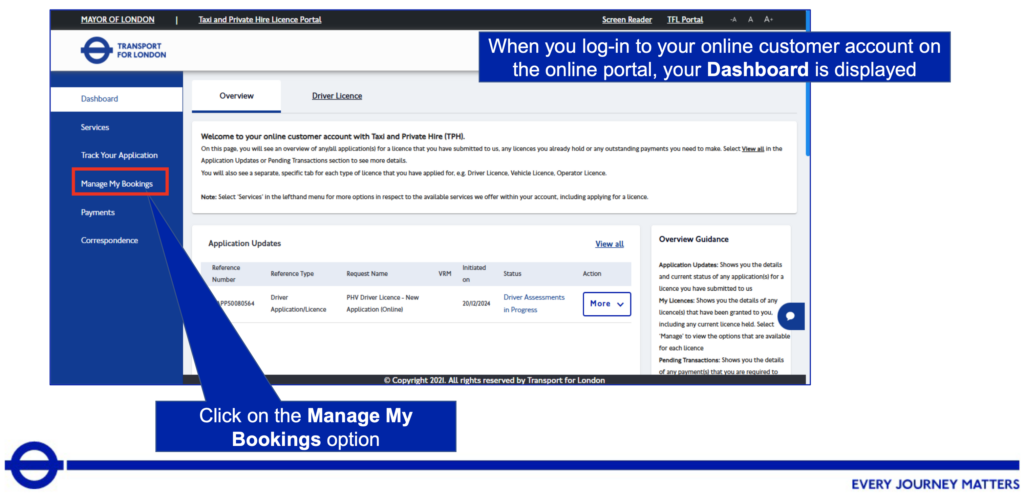
Step 3. Click +New Appointment (button on top right)
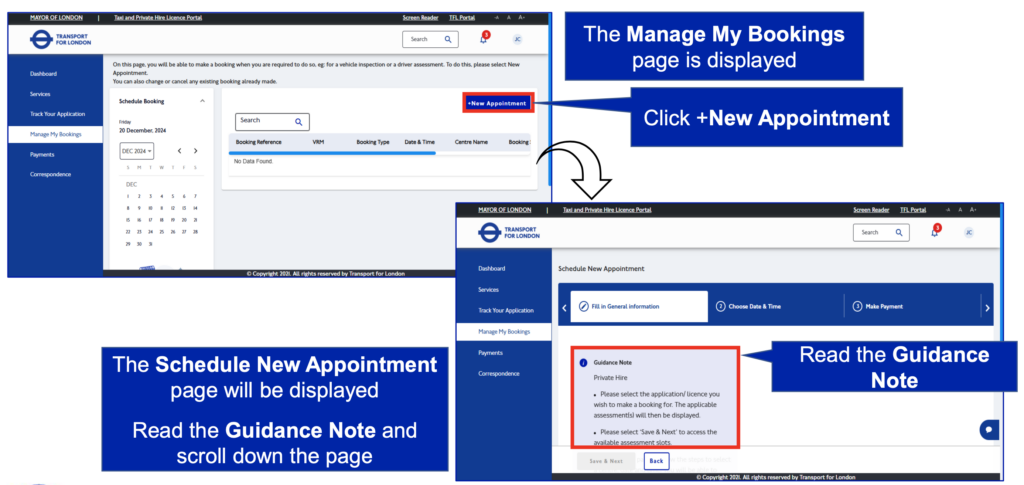
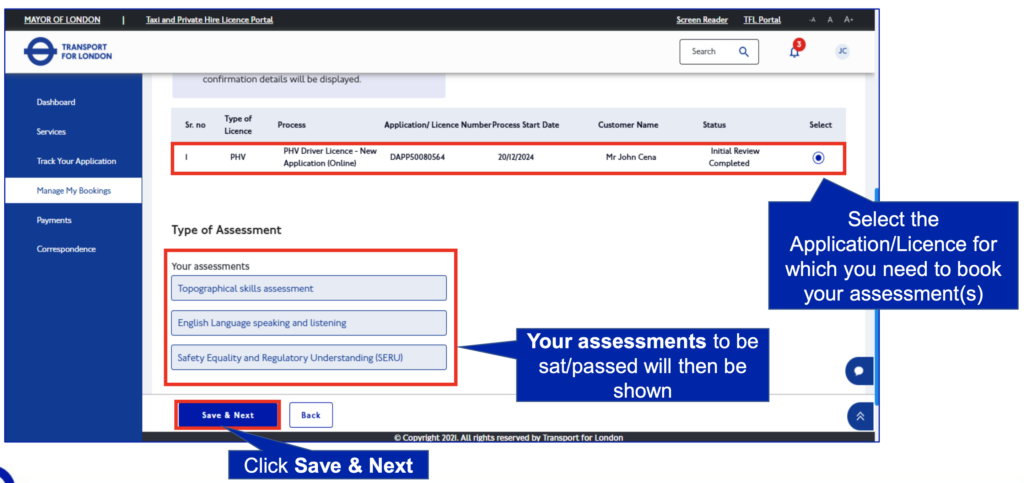
Step 4. Make sure your application is selected. Click Save & Next.
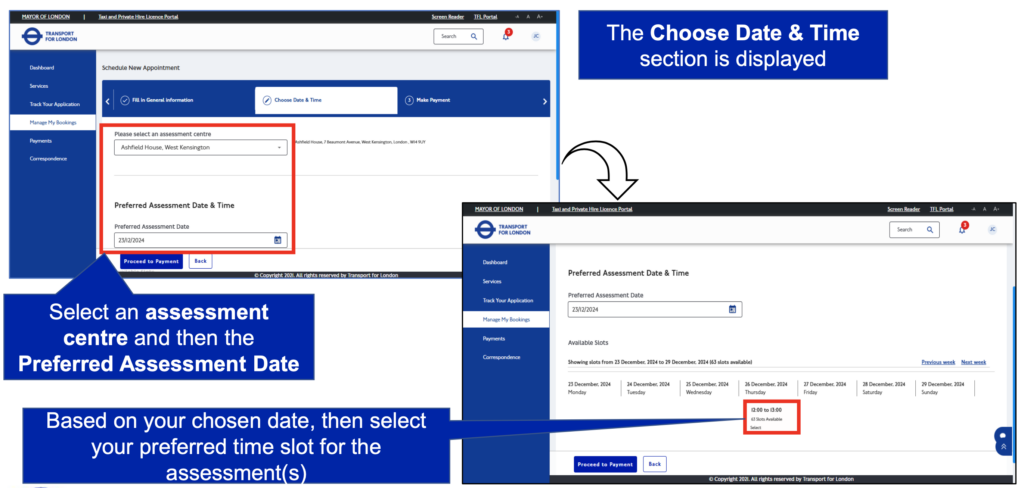
Step 5. Select location and test dates
Step 6. Confirm bookings
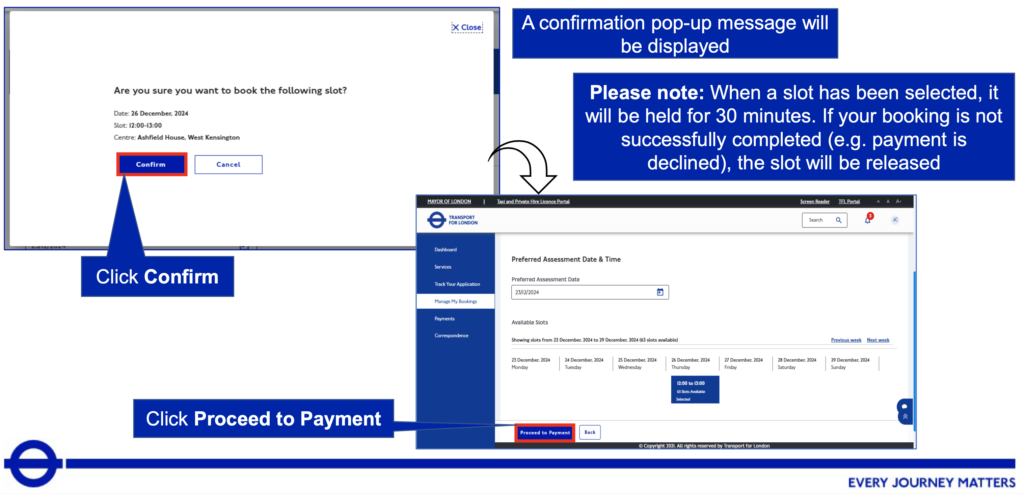
Step 7. Click Pay Now (button bottom left)
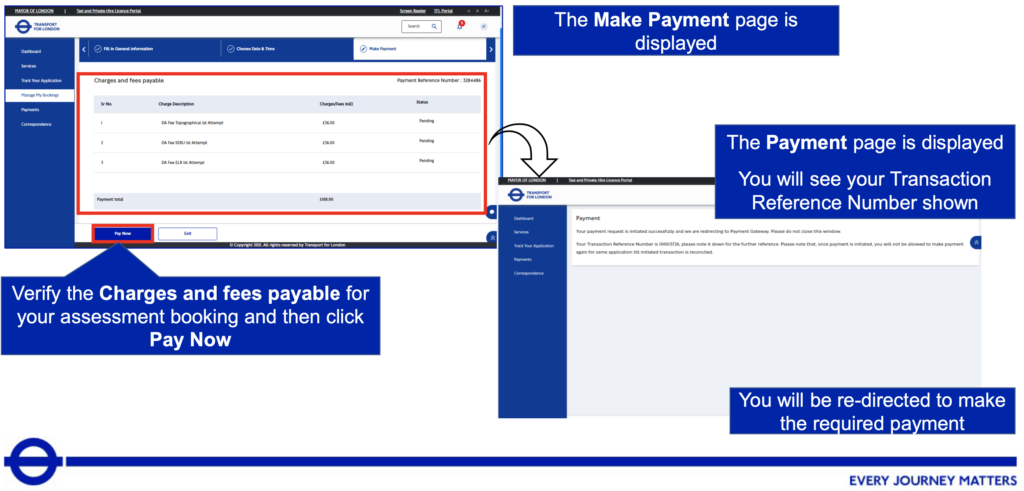
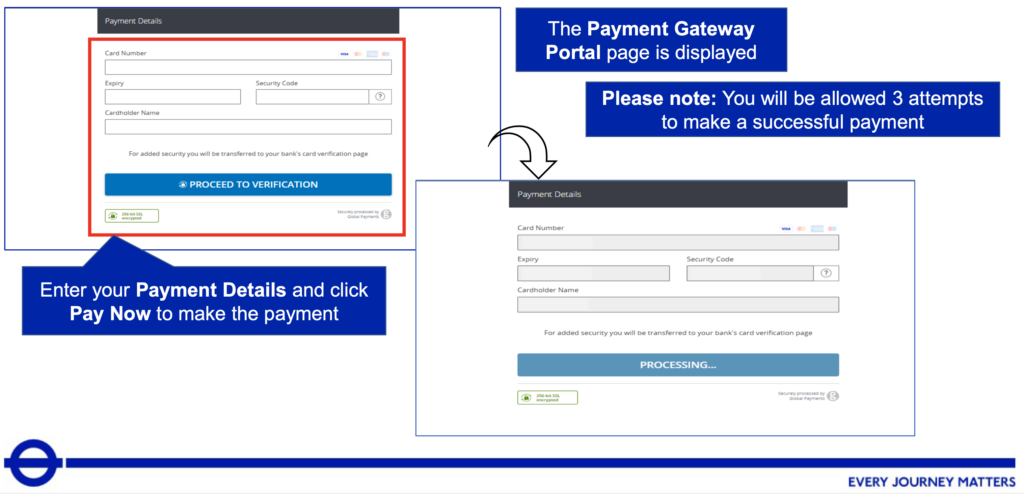
Step 8. Enter card details.
Step 9. Booking confirmation page
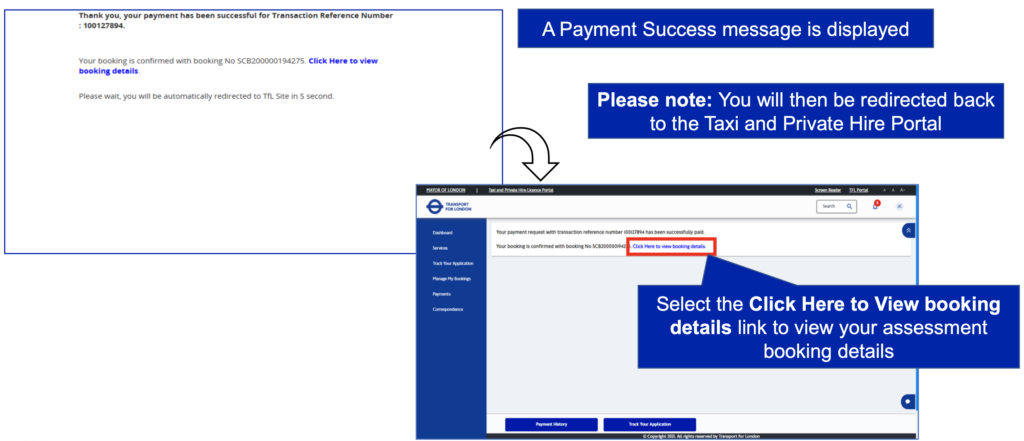
Step 10. Download your Booking confirmation letter
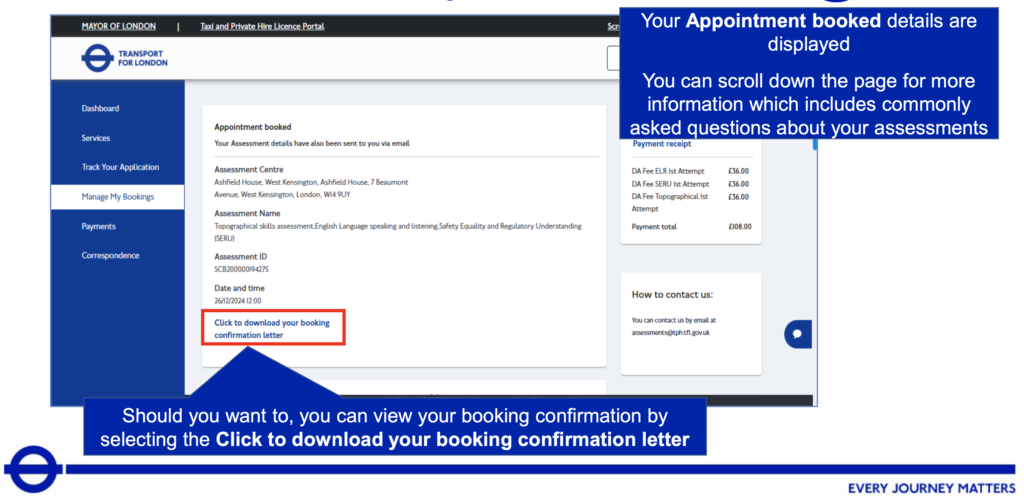
* Please note, TfL must first invite you to book your tests.
If you cannot see the option for booking a new appointment in the portal it means:
You can contact TfL driver assessments booking on 03432224444 or support@tph.tfl.gov.uk

Following from TfL’s e-mail and Sadiq Khan’s announcement, some drivers are unsure about the update.
We have put together this summary to clarify that, according to TfL:
0. The SERU Assessment has not been scrapped / stopped.
1. Group 1 PHV drivers will not lose their licence no matter how many times they fail (as long as they attend).
2. If drivers don’t respond or attend their assessments, TfL may suspend or revoke their licences.
3. TfL is trialling a new SERU style where drivers will have the handbook with them during the test.
4. This trial will only be for some Group 1 drivers.
5. If the trial is successful, TfL may apply this new style to all SERU assessments (after many months).
6. All drivers must pass still pass the SERU assessment.
www.serupractice.com
020 3965 7202
https://wa.me/+447418609836

This is a frequently asked question by existing PHV drivers and new applicants.
If you’re an existing PHV driver, you can find the answer in this short guide.
For new applicants, please read below to find out the process.
New applicants often ask, “Should I complete the SERU assessment before or after submitting my PCO application?”
The current answer is that you will do the SERU assessment after you apply, as TfL will invite you to undertake the assessment. This means you cannot book the SERU assessment yourself.
You must complete your full PCO license application, submit it, and then wait for TfL to contact you via letter or email to book your test date at one of the two locations.
Here is the current step-by-step process for applying for a Private Hire license with TfL to become a minicab driver in London:
1. Register with TfL:
Begin the Private Hire License application process by registering online with TfL. Visit the following link to register.
2. Enhanced DBS check:
Complete your Enhanced DBS check through TfL’s designated service provider to obtain your DBS certificate, which is a criminal background check. You must use TfL’s provider; other providers are not accepted. Access TfL’s DBS provider through this link.
3. Medical check:
Undergo a medical check at your GP’s office using the yellow TfL medical form provided when you log on to complete your private hire application online.
4. HMRC Tax Check:
As you will likely become self-employed as a Private Hire driver, register with HMRC and obtain your unique 9-character tax check code to share with TfL. You can do the check here..
Once you have completed these four steps, submit your Private Hire License application online. TfL will then initiate the processing of your application and proceed with the following steps:
1. Topographical Skills Assessment:
You will receive a letter and email from TfL providing the date, time, and location for your Topographical Skills Assessment. You need to attend the TfL topographical test center to complete this assessment.
2. SERU Assessment:
TfL will send you a letter and email inviting you to book your SERU Assessment. This invitation may come after you have passed the topographical skills assessment and even after your Private Hire License has been issued.
3. Speaking & Listening Assessment:
When you receive the SERU assessment invitation, you may also be asked to take the TfL Speaking & Listening Assessment. For existing private hire license holders, this depends on the status of your English Language Requirement.

The TfL SERU (Safety, Equality and Regulatory) assessment is a test that all existing and new TfL Private Hire Drivers must pass.
The SERU assessment tests drivers:
The SERU assessment is a computer-based test.
You will not need to type any words or write anything on paper. However you will need to be able to use a mouse.
The SERU assessment has 37 questions. There are 3 different question types:
You can try some sample questions of the SERU test here.
The SERU assessment has a time limit of 45 minutes.
The pass mark is 60% or higher for the SERU assessment.
This comprehensive guide will explain how to successfully prepare for the SERU assessment.
Candidates who do not pass the SERU test on the first attempt, are given one attempt to retake the test.
The SERU test must be taken at a TfL test centre. There a few different test locations around London.

Do not wait until you receive your e-mail/letter from TfL inviting you to sit your TfL SERU assessment. TfL has given some drivers as little as one week’s notice to sit their SERU assessment, which may not be enough time.
If you are not sure when your assessment date will be, you can find out using this guide.
Give yourself plenty of time to understand the test requirements, gather study materials, and develop effective study strategies.
Starting early allows for a more comprehensive and focused preparation, increasing your chances of passing.
Before diving into your preparation, familiarize yourself with the format of the TfL SERU assessment. Understand the types of questions, time limits, and scoring criteria.
This will help you tailor your study plan and practice effectively, ensuring that you are well-prepared for the specific demands of the assessment.
You can find a summary of what to expect in the test here.
How long you will need to prepare for your SERU assessment depends on your English reading & writing abilities and computer skills.
Some people will need 2 weeks and others may need 2 months. Remember, everyone’s circumstances is different so focus on your own plan.
Try the Free TfL SERU Practice Questions to get an idea of the level of reading & writing and computer skills needed. The tool will also give you a personalized suggestion of what resources you should use to prepare.
The TfL SERU assessment is based on the PHV Driver’s Handbook which is a 55-page PDF. You can use an online training course to make it easier to study on your mobile wherever you are, in between your daily schedule.
The TfL SERU Practice Online Training Course breaks down the Handbook into 50 short lessons with practice questions at the end of each lesson. It makes it easy to track your progress and practice official format questions.
It is important to focus extra on the aspects you find challenging.
For example, most drivers are familiar with the licensing process which is covered in Section 1. However not many drivers are familiar with the rules on disabled passengers and assistance dogs, covered in Section 9.
Similarly, some question types are easier than others. Most applicants find the Fill-in-the-blanks questions more challenging than the multiple choice questions.
The best way to find out what parts you will find challenging is tracking your progress using an online course.
Mock tests are an invaluable tool for preparing for the TfL SERU assessment. They simulate the actual exam environment, allowing you to practice time management, experience the pressure, and assess your readiness.
Identify your strengths and weaknesses through mock tests and focus on areas that need improvement. Mock tests provide a realistic preview of the assessment, boosting your confidence and performance.
You can access TfL SERU Practice Mock Tests here
Getting expert guidance and support makes preparation for the TfL SERU assessment much simpler. The resources provided by TfL SERU Practice come with daily support via Whatsapp, where you can access valuable insights, ask any question and get the help you need to prepare effectively.
The TfL SERU assessment has a pass mark of 60%, which is not high. This means all candidates who spend enough time preparing will have no trouble passing. It is important to always remain calm and to not stress. The earlier you begin preparing, the more you can avoid being stressed.
By following these essential tips and strategies, you can excel in the TfL SERU assessment. Remember to start early, understand the test format, create a study plan, focus on key areas, seek support, take mock tests, and build confidence. With dedicated effort and proper preparation, you can be confident you’ll pass.


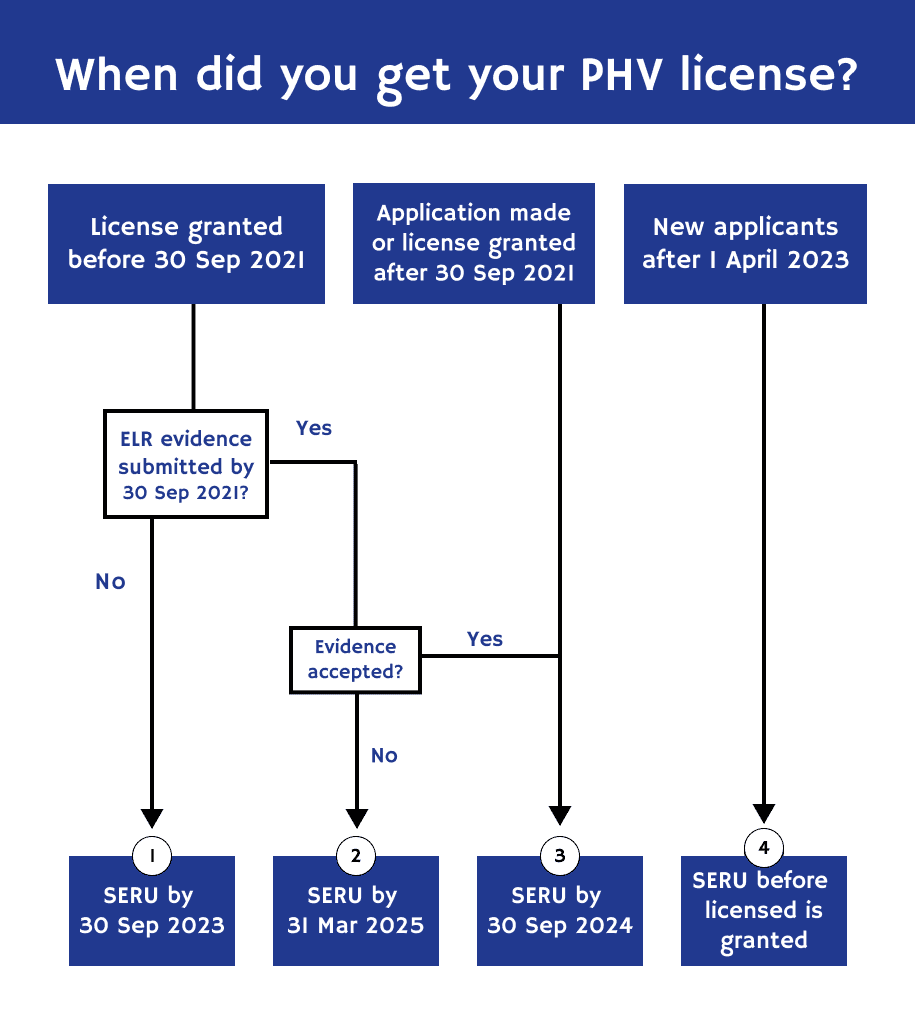
For Private Hire Drivers who have successfully fulfilled their English language requirement within the specified timeframe and had it accepted by TfL, there is no need to undergo an additional speaking and listening test with TfL.
However, they are still required to complete the SERU Assessment by 31 March 2025. If you would like more information about the SERU deadline and dates, please refer to our blog.
If you submitted your English language requirement late (after 30 September 2021) or if TfL did not accept your evidence, you will be required to complete both the SERU assessment and the TfL speaking and listening test. Additionally, all new applicants for a Private Hire driver’s license must fulfil both the SERU assessment and the speaking & listening test requirement.
The previous English Language Requirement by TfL has been replaced by the SERU assessment, which covers the Reading and Writing components, while the Speaking and Listening test focuses on the remaining aspects.
Information on the TfL Speaking & Listening Test:
Similar to the SERU assessment, the cost for the Speaking and Listening test with TfL is £36, and if you fail the test on the first attempt, you have the opportunity to re-sit it once for £16. You are allowed only two chances to pass the test.
The Speaking and Listening test is conducted at a TfL office and is facilitated through a secure video or telephone link with a company called PeopleCert’s.
Breakdown of the Speaking & Listening Test for Private Hire Drivers:
* The speaking and listening test typically takes approximately 15-20 minutes to complete.
* The pass mark for the test is 60/100 (60%).
* The test consists of 5 parts, which we will outline in detail below.
The TfL Speaking & Listening Test: Breakdown of 5 Parts
1. Personal Information and Subject Discussions: The test begins with the examiner engaging in a conversation with you, asking personal questions such as your name. Then, you will discuss four subjects provided by the examiner. For instance, you might be asked about your internet usage or what you had for breakfast. These discussions will be brief, with one question per subject, and you can respond with a single sentence.
2. Situational Role Play: In this part, the examiner will present four situational subjects to initiate a role play. For example, they may act as a waiter in a café while you pretend to express dissatisfaction with the food. You will engage in a conversation with the examiner, playing out the scenario.
3. Image-Based Discussion: Part 3 involves a discussion with the examiner based on presented images. The examiner will use the information depicted in the pictures to initiate conversation, and you will continue the discussion using other images provided.

4. Listening Comprehension: In the fourth part, the examiner will read a paragraph aloud, and you need to listen attentively. Following the reading, you will be given three questions based on the content. Take notes of potential answers using the provided pen and paper. Subsequently, you will verbally provide answers to the three questions.

5. Extended Speaking: The final part requires you to speak for approximately one and a half minutes on a topic presented by the examiner. For instance, the examiner might ask about your favourite movie. You will have half a minute to take notes on the points you want to discuss. The examiner may ask follow-up questions related to the topics you mentioned during your speech.
If you need help passing your Speaking & Listening test, we have tutors fluent in a range of languages including Urdu, Bangla, Pashto, Dari and Somali to help you pass your test.
Just get in touch with us via our Whatsapp Support Desk.
Given that all private hire drivers eventually need to complete the TfL SERU assessment, it is important to be well-prepared.
To pass the TfL SERU test, you must undergo an examination at a TfL centre. The test lasts for 45 minutes and includes 37 questions. In order to pass, you need to achieve a score of 60% or higher.
The 37 questions include: 18 multiple-choice questions, 2 reading and understanding questions, and 17 drag and drop questions. You can try free sample TfL SERU Assessment questions here. Let’s delve into these question types below.
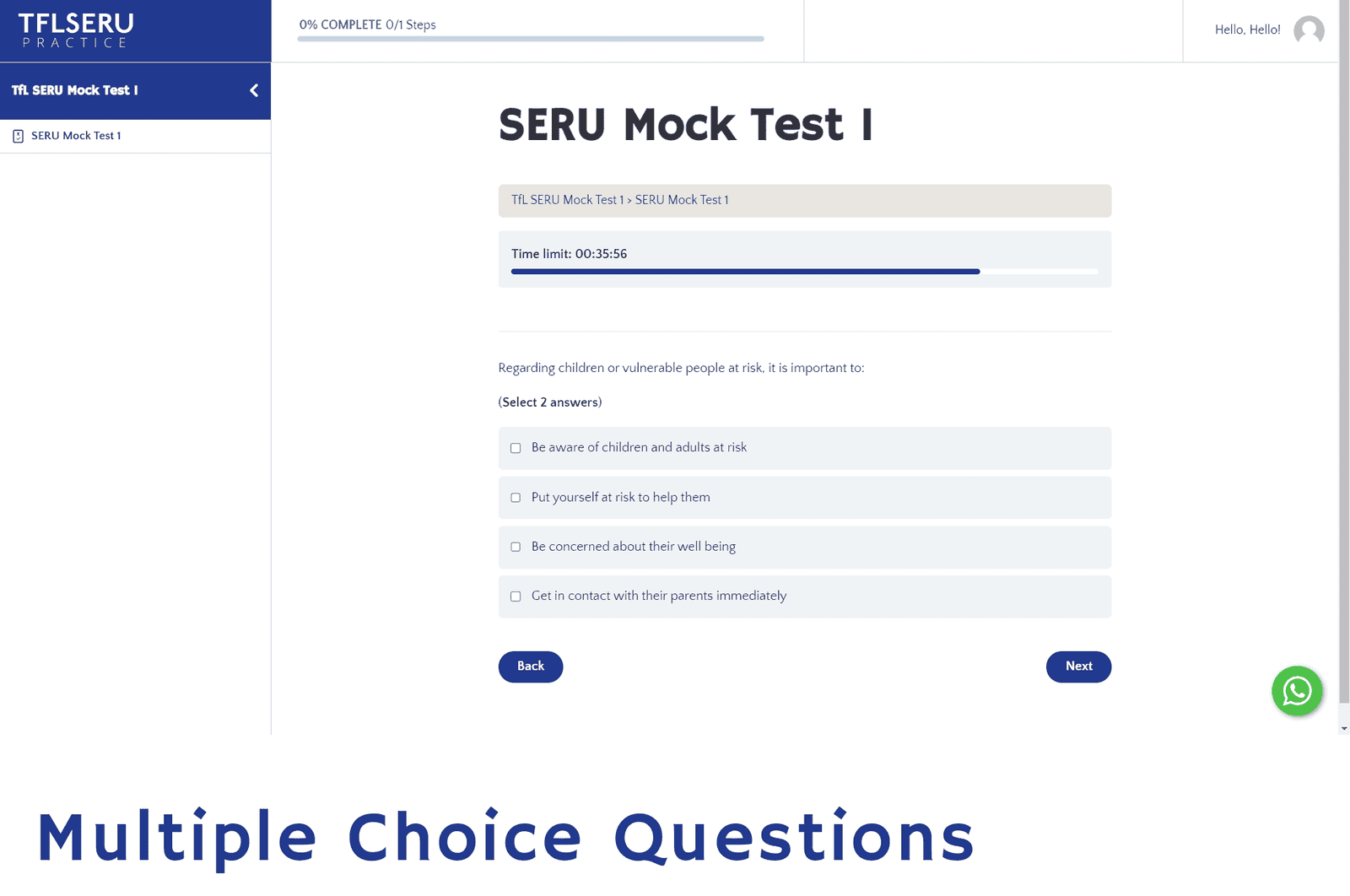
These questions are based on the 10 sections of the TfL PHV Driver’s Handbook. As the name implies, each question presents multiple answers to choose from, with the requirement of selecting one correct answer in most cases.
However, be cautious, as some questions may ask for two answers. Take your time to read these questions carefully and select the appropriate number of answers.
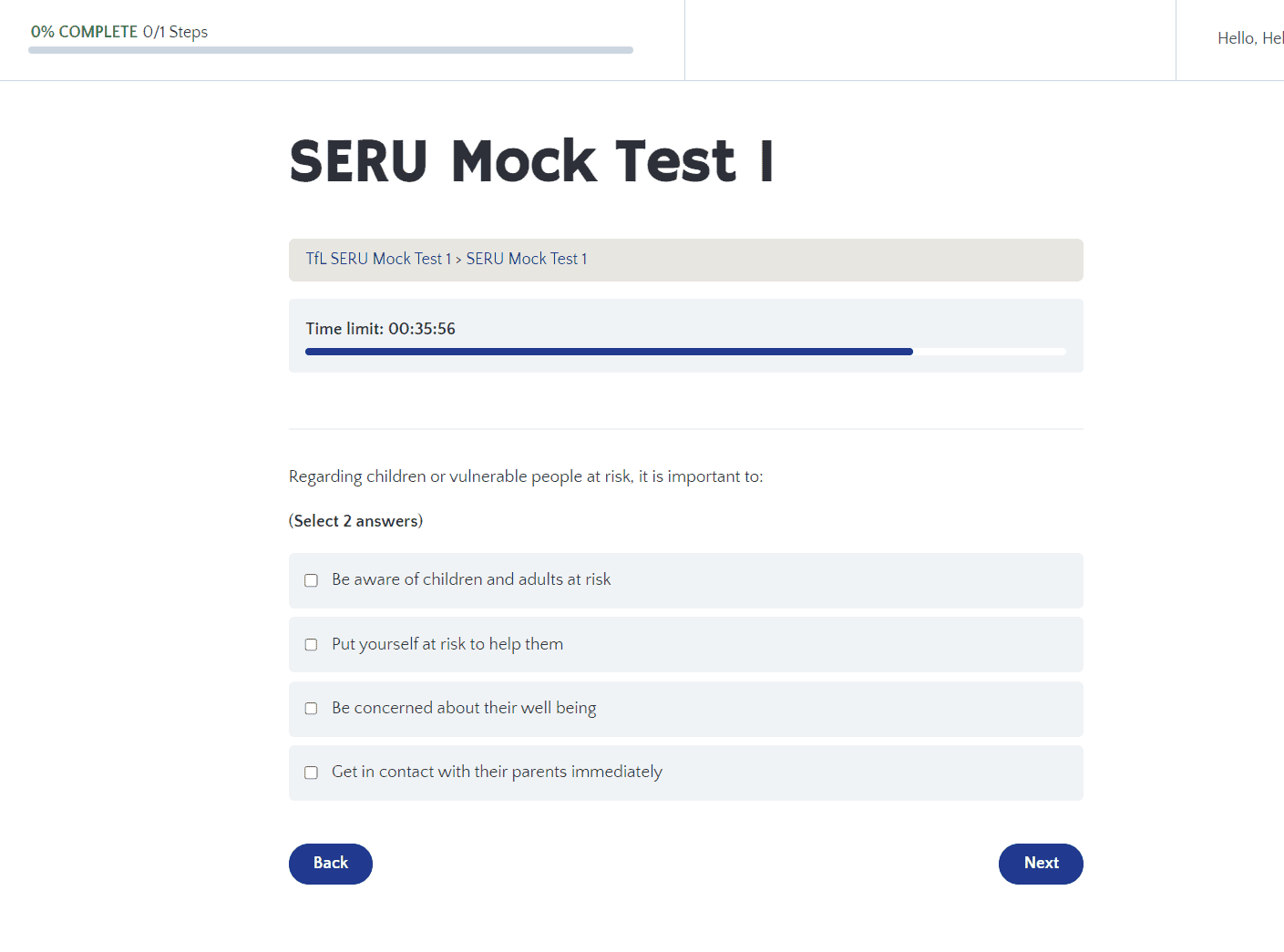
Here’s an example of a multiple-choice question:
Although only two of these questions appear on the test, they hold significant importance since they are not necessarily based on any sections of the TfL PHV Driver’s Handbook.
These questions involve a paragraph that requires reading and comprehension, followed by selecting a true statement based on the given paragraph.
Here’s an example of a Reading & Understanding Question:
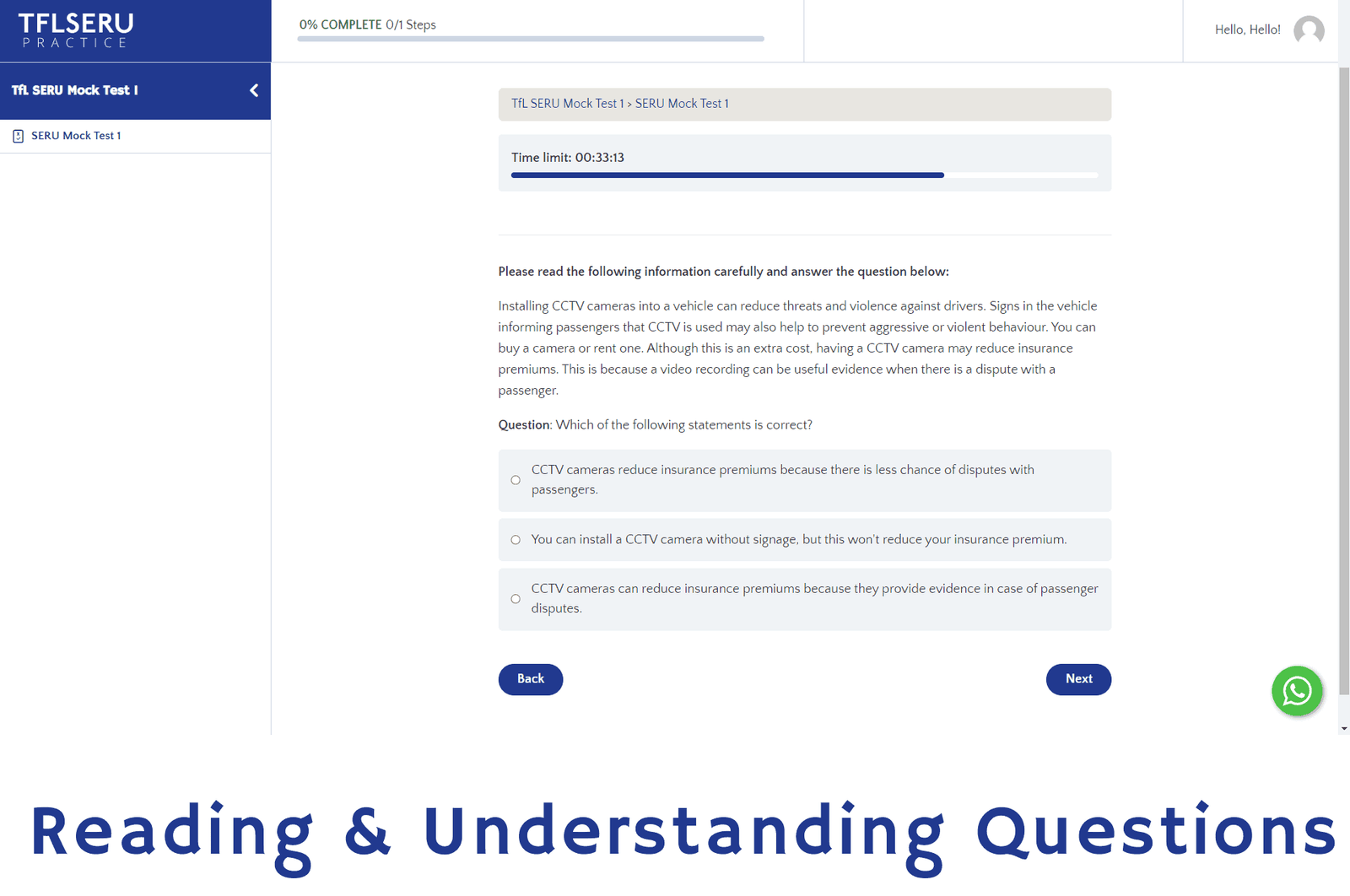
These questions are relatively straightforward but may require some practice to become accustomed to. Similar to the multiple-choice questions, they are based on sections of the TfL PHV Driver’s Handbook.
In these questions, you are presented with a sentence containing gaps that need to be filled with words. You can select the appropriate words from a list provided below and drag them into the gaps.
An essential aspect of the drag and drop questions is ensuring that any unused words are placed in the pink box before submitting your response. Each sentence will have three missing words, and you can choose from a selection of six words.
Pay attention to the spelling of the words, as some commonly have spelling mistakes made by people.
Here’s an example of what a TfL SERU Drag & Drop Question looks like:
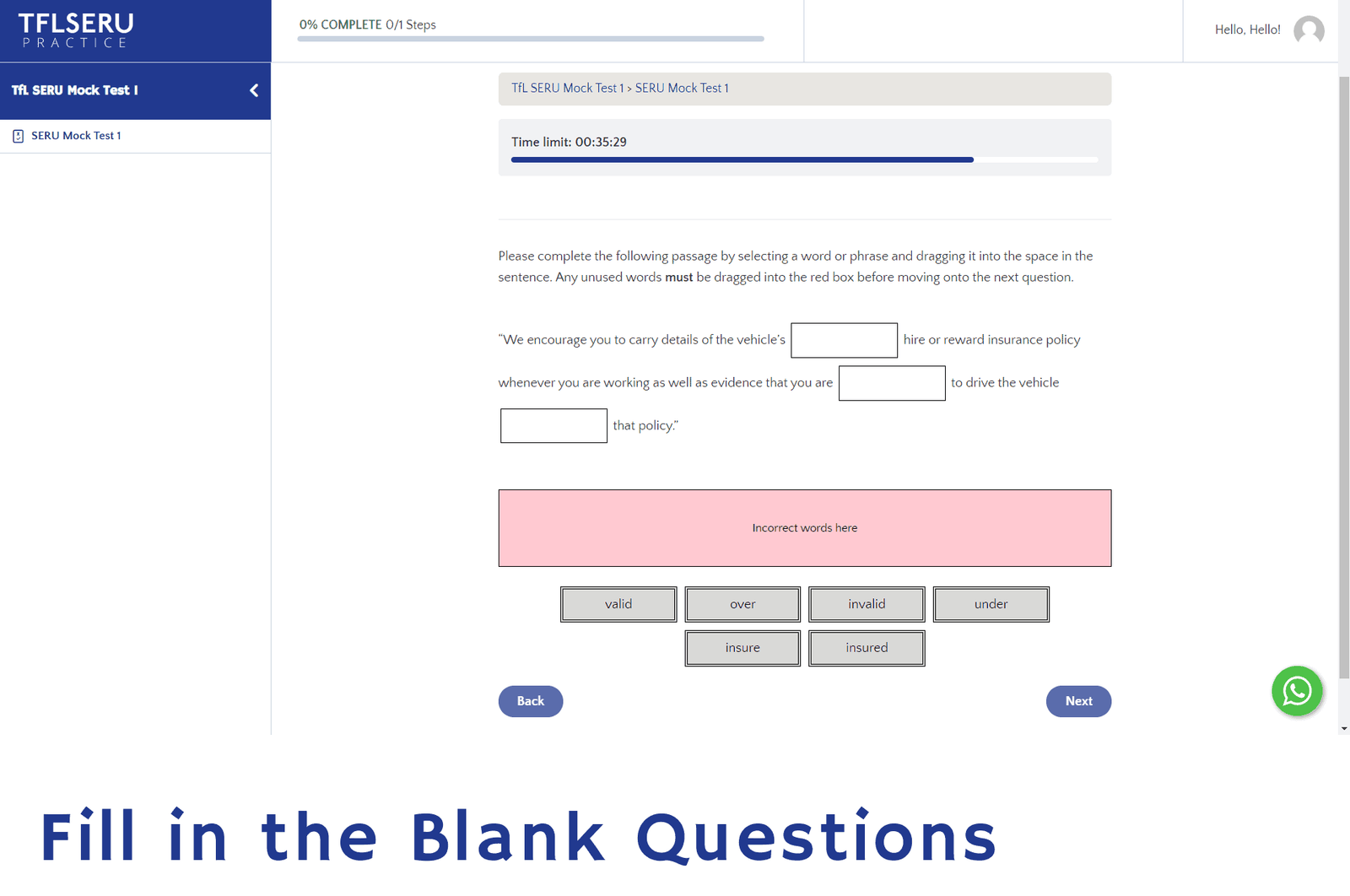
To gain a realistic experience of the TfL SERU assessment, we encourage you to sign up for TfL SERU Online Training courses, which includes a timed mock test and official format questions from the TfL SERU assessment.
By adequately preparing for the test, you maximize your chances of success. Passing the assessment secures your license, saves you time, and reduces expenses.
There are a range of SERU mock tests and SERU mock test packs for you to practice here.
If you have any questions, reach us on Whatsapp via the icon below.

Amongst drivers, there is confusion as to whether the SERU assessment is required for everyone.
In this blog, we will answer the most commonly asked questions.
Yes, even if you provided a B1 English certificate for speaking and listening you must sit the SERU assessment.
Yes, all new and existing drivers must pass the SERU assessment, no matter how long they have been licensed for.
No. You must still take the SERU assessment. It is mandatory for all drivers regardless of their educational background.
No. You must still take the SERU assessment.
In conclusion, all PHV drivers must take the SERU assessment at some stage. The deadline for each driver will vary, depending on whether they have already met the English Language Requirement for Speaking & Listening.