Blog

  • (PHV) SERU Assessment 2026 – Full Guide

    (PHV) SERU Assessment 2026 – Full Guide

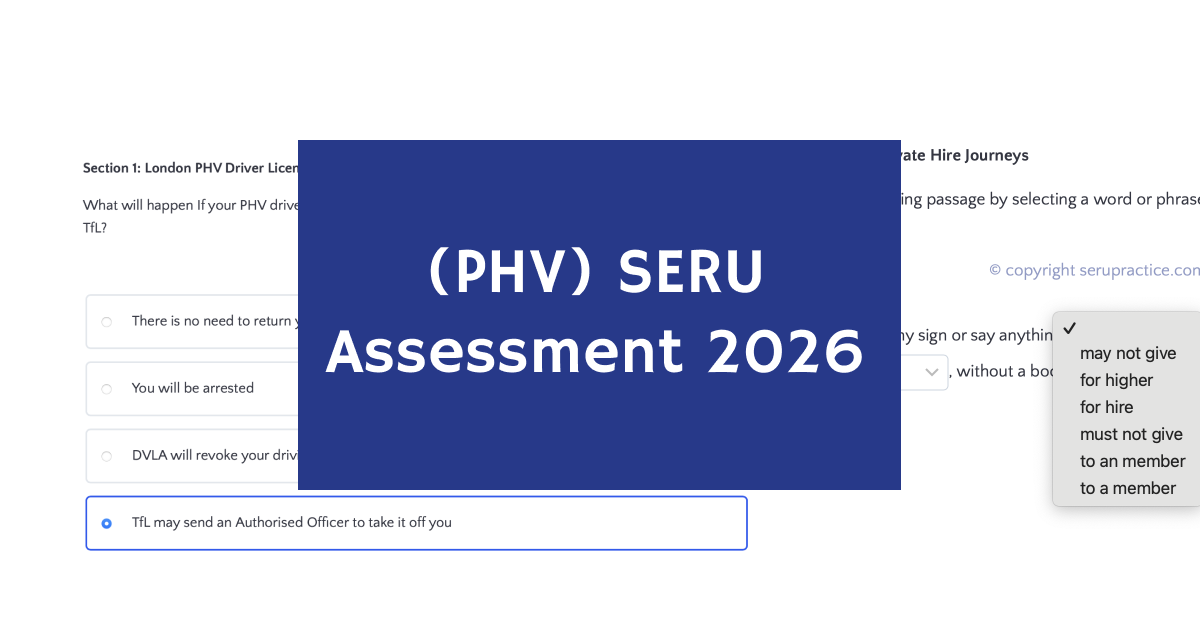
    SERU stands for Safety, Equality & Regulatory Understanding. It is a TfL assessment that checks you understand the rules, safety responsibilities, and equality and safeguarding duties expected of TfL private hire (PHV/PCO) drivers.

    Test length and structure

    • 60 minutes total time
    • 36 questions in total
    • Computer-based assessment
    • Open book (handbook provided at the test centre)

    What is the SERU assessment?

    • A computer-based knowledge assessment for London PHV drivers.
    • It is based on the official TfL PHV Driver’s Handbook.
    • The assessment is open book. You are given a copy of the handbook at the test centre.

    How to pass (simple, effective plan)

    1. Read the official handbook properly
      • SERU is based directly on it, and you will use it in the test (open book).
    2. Practise in the official format
      • Do timed mock tests so you learn how to find answers fast in the handbook.
      • If you want a full step-by-step prep program, use the TfL SERU Online Course.
    3. Focus on fill-in-the-blank accuracy
      • Unanswered blanks are marked incorrect, so always attempt every blank.
      • If you’ve failed before, your fastest improvement usually comes from heavy fill-in-the-blank practice.
      • Use the SERU Fill in the Blanks Questions pack for targeted practice.
    4. Do full mocks under exam timing
      • 60 minutes, no distractions.
      • Review mistakes and re-check the relevant handbook sections.
      • Use the official-format TfL SERU Mock Test Pack to practise in the closest style to the real exam.

    Who has to take it?

    • All new PHV licence applicants (you cannot get a PHV licence without passing SERU).
    • Existing PHV drivers may also need to pass SERU as part of licensing requirements (especially if you were licensed before SERU was introduced).

    When do you need to take it?

    • For new applicants: after you submit your PHV application and before TfL can issue your licence.
    • For existing drivers: you must pass before TfL renew your licence.

    Question types

    • 22 Multiple Choice questions (MCQs)
    • 12 Fill-in-the-blank (dropdown format)
    • 2 Reading & Understanding (short passages with questions)

    Pass mark

    • 60%
    • That means at least 23 out of 36 correct.

    Attempts

    • New applicants: up to 3 attempts.
    • Existing drivers: unlimited attempts (as long as you attend).

    Costs

    • First attempt: £40
    • Resit: £30

    Quick FAQ

    • Can I skip and return to questions? Yes.
    • Do you get partial marks on fill-in-the-blanks? Yes, partial credit is awarded for partially correct answers.
    • Can I use pen and paper? No.

  • Taxi (Black Cab) SERU Assessment 2026 – Full Guide

    Taxi (Black Cab) SERU Assessment 2026 – Full Guide

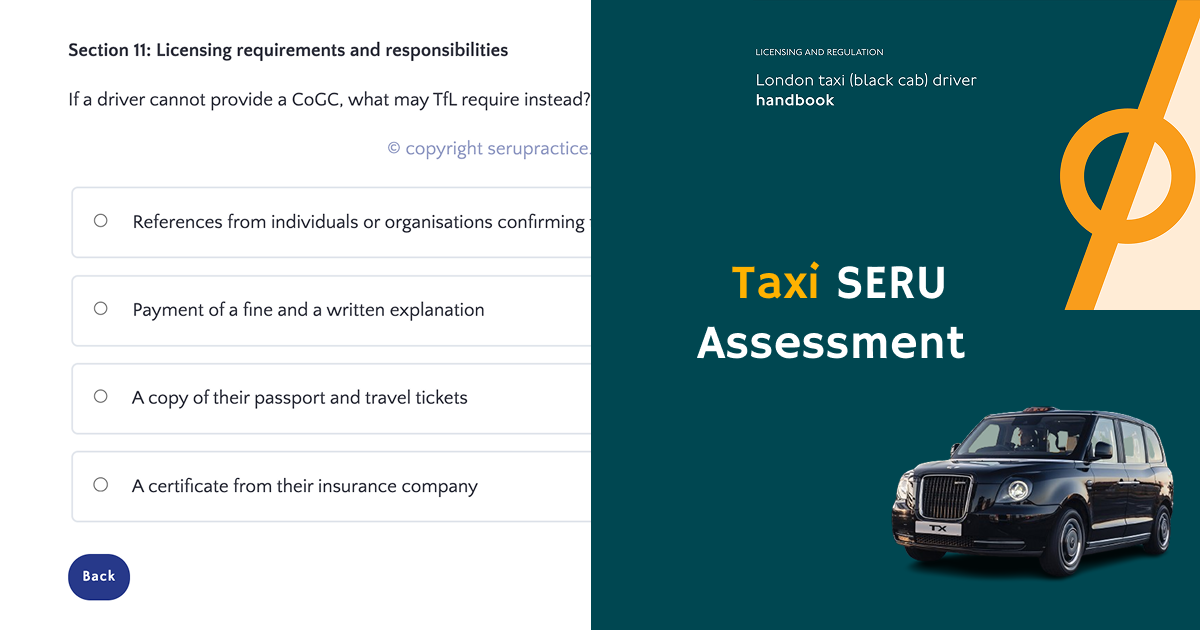
    This guide is for the TfL Taxi (Black Cab) SERU Assessment (not PHV SERU).

    Test length and structure

    • Total time is 60 minutes.
    • Computer based (no pen or paper)
    • 36 questions

    ???? Goal: Plan routes on map software, identify locations and navigate maps using directions.

    Everything you need to know about the Taxi (Black Cab) SERU Assessment (2026)

    The Taxi SERU assessment is TfL’s Safety, Equality and Regulatory Understanding test for London taxi (black cab) drivers. It checks that drivers understand day-to-day responsibilities around safety, equality, passenger support, safeguarding, and the key rules set out in the Taxi Driver Handbook.

    This guide focuses on what the assessment is, who it applies to, how the day works, and how to prepare efficiently.

    What is the Taxi (Black Cab) SERU assessment?

    • A TfL assessment that checks your understanding of safety, equality and safeguarding duties, regulations, and driver responsibilities.
    • It is based on the official Taxi Driver Handbook. Use this as your main study material: TfL Taxi Driver Handbook (latest version)

    Who needs to take Taxi SERU, and when?

    Taxi SERU applies to two main groups:

    • New applicants applying for a taxi driver licence on or after 1 October 2025. You normally sit the assessment before you can be licensed (often around Stage 4 or 5).
    • Existing licence holders whose licence expires on or after 1 October 2025. You must pass before TfL can renew your licence.

    If you submit your renewal before your licence expires, TfL may allow you to continue working for up to 12 months while you complete and pass SERU (depending on the rules for your specific case).

    Where the assessment happens, and what to bring

    The assessment is taken at the TfL driver assessment centre, 14 Pier Walk, London SE10 0ES (near North Greenwich).

    Bring:

    • Original photo ID
    • A payment card

    Format, timing, and pass mark

    Taxi SERU is completed on a computer and lasts 60 minutes. There are 36 questions, and the pass mark is 60%.

    The questions include:

    • 22 multiple-choice
    • 12 fill-in-the-blank
    • 2 reading and understanding questions

    You can skip questions, flag them, and return later. There is no negative marking, so it is worth making an educated guess if you are stuck.

    Is it open book?

    Yes. Taxi SERU is open book, and TfL provides a copy of the handbook at the assessment centre (you cannot bring your own copy).

    Because you only have 60 minutes for 36 questions, speed matters. Many candidates find it challenging not because the content is complicated, but because it is easy to lose time searching through the handbook.

    Booking, fees, retakes, and results

    TfL will usually contact you as your licence expiry approaches. If you want to book earlier, you can email assessments@tph.tfl.gov.uk.

    Fees are typically:

    • £40 for the first attempt
    • £30 per retest

    If you do not pass, you can usually retake the assessment (fees apply). Results are commonly issued within 15 days, but it can take longer.

    Safeguarding requirement (do this first)

    Before you sit Taxi SERU, you must complete the Safeguarding Awareness Course. This is an online video course that you complete at home, and it is not supervised.

    Link: TfL Safeguarding

    Taxi SERU vs PHV SERU (they are not the same)

    Taxi SERU is for taxi drivers and is not the same as the SERU used for private hire (PHV) licensing. The two assessments use different handbooks and different content structures. Taxi SERU is typically based on 12 sections, while the PHV SERU handbook is typically structured into 10 sections. PHV licensing also includes a separate B1 Speaking and Listening English test.

    How to revise and pass (without wasting time)

    Most people pass by doing two things consistently:

    1. Read the Taxi Driver Handbook so you know where information is located.
    2. Practise timed mocks in the same style as the real test until you are comfortably scoring 70%+.

    Use our official-format mock pack here: TfL Taxi (Black Cab) SERU Mock Test Pack

    A common revision timeline is around 2 weeks, but it depends on English reading speed and computer confidence.

    English level and accessibility support

    You will need good English reading skills to work quickly under time pressure.

    If you have a disability or learning difficulty, TfL may be able to provide reasonable adjustments if you submit evidence. Email assessments@tph.tfl.gov.uk to request support.

  • How to Pass TfL Topographical Skills Assessment 2026 – Full Guide

    How to Pass TfL Topographical Skills Assessment 2026 – Full Guide

    Test length and structure

    • Total time is 70 minutes.
    • Computer based
    • 24 questions

    ???? Goal: Plan routes on map software, identify locations and navigate maps using directions.

    The TfL Topographical Skills Assessment (often called TOPO) is a map-reading and route-planning test for PHV applicants. It checks whether a driver can read on-screen maps properly, find locations quickly, and plan legal, sensible routes across London.

    How to prepare (and pass first time)

    The fastest way to improve is to practise exactly what the test asks you to do: route planning rules, timed MCQs, and On-screen maps reading.

    A structured option is the TfL Topographical Course Package, which is a self-study course covering all question types, including route planning practice with video solutions, On-screen map reading question practice, and full mock tests.

    During the exam, remember you are allowed to skip questions and return to them later, so do not get stuck too long on one question early on.

    One-to-one Topographical training (route planning help)

    For students who need extra support (for example, basic English, failed once, or need help using the computer), there is one-to-one Topographical training.

    The one-to-one lessons focus on route planning only. They are delivered 100% online in a live classroom with screen sharing, so the instructor can see the screen and guide the student in real time. Lessons are typically one hour each, and many students need around 7 hours total depending on level and progress.

    These lessons do not include self-practice access outside of lesson time, so students who want extra practice usually combine lessons with a self-study course.


    Question types in details (and what they test)

    You will typically see three areas:

    Route planning tasks: These check whether you can plan a route between two places using correct rules. Route planning is the most important part of the exam, because it is worth the majority of the marks.

    Compass and direction questions: These test basic direction skills (North, South, East, West) and how junctions and roads relate to each other.

    On-Screen Map question: These test require you to find information on the map by reading the map.

    Test format (what happens on the day)

    The assessment is a practical, computer-based test. You will use a computer at the test centre and you will also be given an A-Z Master Atlas of Greater London during the exam. It is open book, but sat-nav is not allowed because TfL wants to test real map skills. Pen and paper are not allowed, but you can request a magnifying glass if needed.

    The test lasts 70 minutes and contains 24 questions. These are a mix of route planning tasks and multiple choice questions based on compass directions and on-screen map reading.


    Who needs to take the Topographical test?

    Most new PHV driver applicants need to pass the Topographical test, unless they qualify for an exemption (for example, already being a licensed London Taxi driver).

    When do you take it?

    You usually take the Topographical test after submitting your PHV licence application and before TfL can issue your licence. You book it through your TfL portal once you are invited.

    Where is the test held?

    The Topographical assessment is held at TfL-approved test centres, and candidates book through their TfL portal account.

    Pass mark (and how the marks work)

    You need 60% to pass. Not all questions are worth the same.

    Route planning carries most of the marks (around 66% of the total). Compass questions are typically worth more than A-Z multiple choice questions, so the best strategy is to treat route planning as the priority and avoid losing easy marks on compass questions.

    Attempts and costs

    Your first attempt typically costs £40 and a resit costs £30. Candidates usually have two attempts. If both are failed, TfL may require the applicant to restart the licence application process.

  • How much does a London Uber driver earn? – Calculator

    How much does a London Uber driver earn? – Calculator

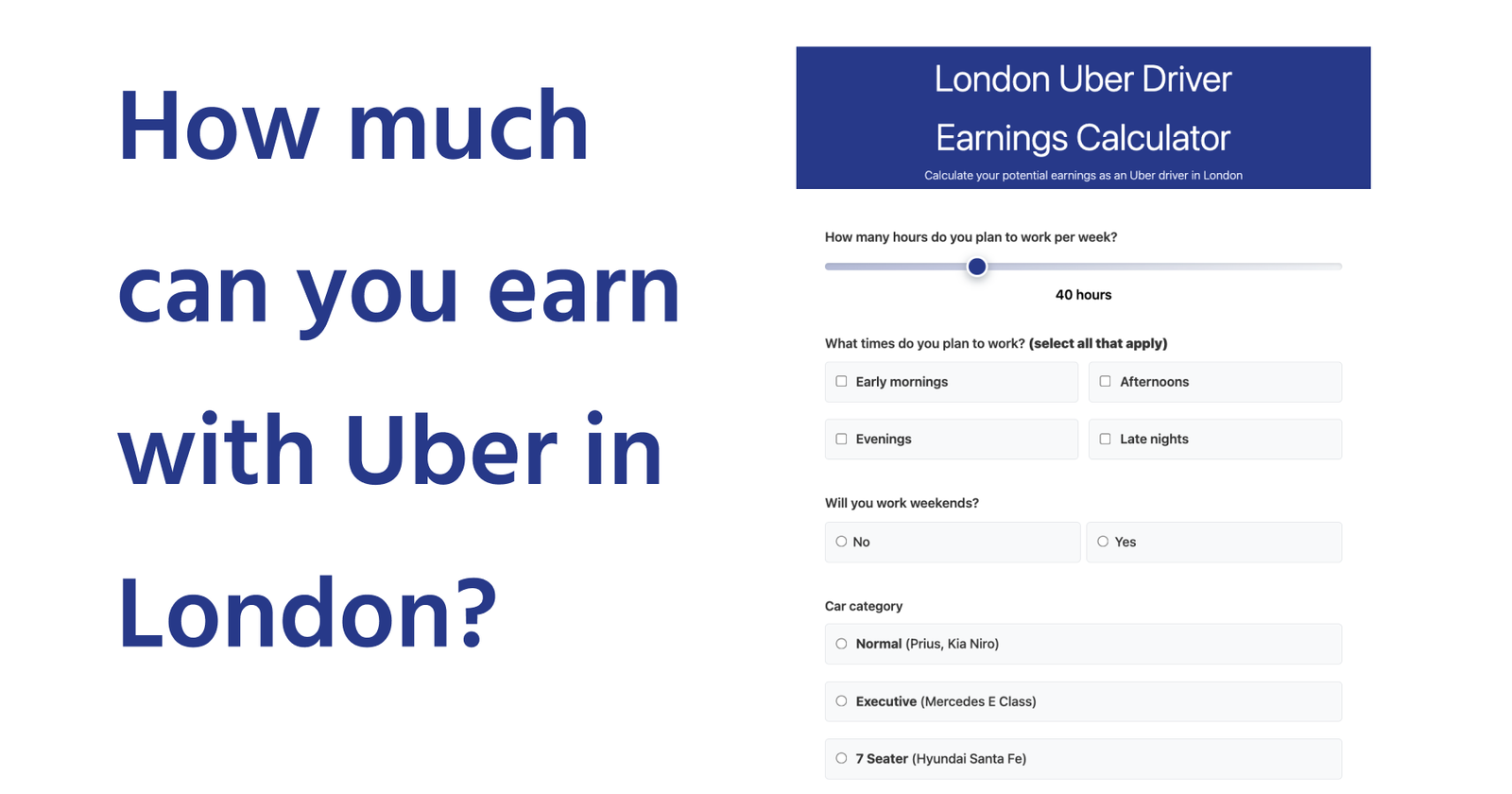
    Are you thinking of becoming an Uber driver in London? Have you wondered if it will be worth your time? Now you can get an estimate of what your earnings may look like based exactly on your circumstances—such as the hours you’ll work or the car you’ll drive. It will also give you an idea of the costs.

    What you’ll find out

    The calculator shows you:

    • How much you could earn per week and per hour
    • What your vehicle will cost (including insurance)
    • Your actual take-home pay after all expenses

    All estimates are based on real data from 200 London drivers in 2025, so you’re getting realistic figures, not guesswork.

    How it works

    Simply tell the calculator:

    • How many hours per week you plan to work (20–90 hours)
    • When you’ll be working (early mornings, afternoons, evenings, late nights—you can pick multiple times)
    • Whether you’ll work weekends
    • What type of car you’ll drive (Normal like Prius or Kia Niro, Executive like Mercedes E Class, or 7 Seater like Hyundai Santa Fe)

    The calculator then shows you exactly what you could earn based on your specific situation.

    What you need to know

    Hourly earnings are based on online time—meaning the time you’re logged into the apps, not just when you’re actively driving. This includes time waiting for rides, time driving between pickups, and quieter periods. This gives you a realistic picture of what you’ll actually earn when you’re online with Uber, Bolt, Wheely, or Exec.

    The data comes from 200 London drivers in 2025 and reflects current rates, TfL requirements, and real-world costs across all these platforms.

    Try it now

    Use the calculator to see your potential earnings. It takes less than a minute, and you’ll get a clear breakdown of what you could earn based on your exact circumstances.


    Open the Uber Earnings Calculator

    Estimates are based on 2025 data from 200 London drivers. Actual earnings may vary based on individual circumstances.
  • TfL Taxi Driver SERU Assessment

    TfL Taxi Driver SERU Assessment

    ???? What London Taxi Drivers Need to Know About the TfL SERU Assessment

    Starting 1 October 2025, all licensed London taxi drivers will be required to pass the Safety, Equality and Regulatory Understanding (SERU) assessment. This new requirement is part of Transport for London’s effort to align with national standards and ensure drivers are fully equipped to serve the public safely and professionally.

    ???? What Is the SERU Assessment?

    The SERU test evaluates a driver’s understanding of:

    • Taxi fares and payments
    • Equality and disability awareness
    • Safeguarding responsibilities
    • Safe driving and passenger safety
    • Licensing rules and regulations

    It’s based on the official Taxi Driver Handbook, and drivers must also complete an online safeguarding awareness course before taking the test.

    ???? Who Needs to Take It?

    • New applicants: Must pass the SERU assessment before being licensed.
    • Existing drivers: If your licence expires on or after 1 October 2025, you’ll need to pass the SERU test before renewal.

    ???? What to Expect in the SERU Test

    While the exact structure and format of the Taxi SERU assessment has not yet been officially confirmed, it is expected to closely follow the format used for the Private Hire Vehicle (PHV) SERU assessment. Transport for London may release further details closer to the rollout date, so it’s a good idea to check back for updates.

    Based on the PHV SERU format, here’s what drivers are likely to encounter:

    • Duration: Around 45 minutes
    • Format: Computer-based, with a mix of multiple-choice questions and sentence completion
    • Number of Questions: Typically 36 questions
    • Passing Score: A minimum of 60%
    • Open Book: The PHV SERU is an open book exam, allowing reference to the official handbook during the test
    • Pre-Test Briefing: Includes a short presentation and sample questions before the test begins

    These details are subject to change, so keep an eye on our posts for the latest updates.

    ???? Where Is It Held?

    Assessments take place at TfL’s Pier Walk Assessment Centre in North Greenwich, the same location used for Knowledge of London appearances.

    This move ensures that black cab drivers meet the same safety and regulatory standards as other transport professionals, while recognising the unique demands of the taxi trade. It’s not just a test—it’s a step toward a safer, more inclusive London.

    Want help preparing for the SERU or accessing the Taxi Driver Handbook? Drop us a message and we’ll point you in the right direction.

    Let me know if you’d like this styled for your WordPress theme or expanded into a longer guide!

  • TfL Taxi Driver Handbook – Latest Version Download

    TfL Taxi Driver Handbook – Latest Version Download

    This is the most up to date version of the handbook, as of today,

    [wpdts-date]

    Download handbook

    Please note that the Handbook does not contain any questions or answers.

    The Taxi Driver’s Handbook serves as a practical guide for Taxi drivers, offering invaluable assistance and is what the Tax Drivers SERU assessment is based on.

    The Handbook is subject to periodic review and may undergo alterations or amendments to align with any legal modifications or changes in TfL policies and guidance.

  • How to book TfL SERU Assessment 2025

    How to book TfL SERU Assessment 2025

    As of March 2025, TfL PHV drivers and new applicants can book their SERU and Topographical assessments online.

    To book your assessments, you will need to login to the new portal.

    You can use your existing / old TfL PHV account details to login.

    Once logged in, follow the instructions below to book your assessments.


    Click here to book

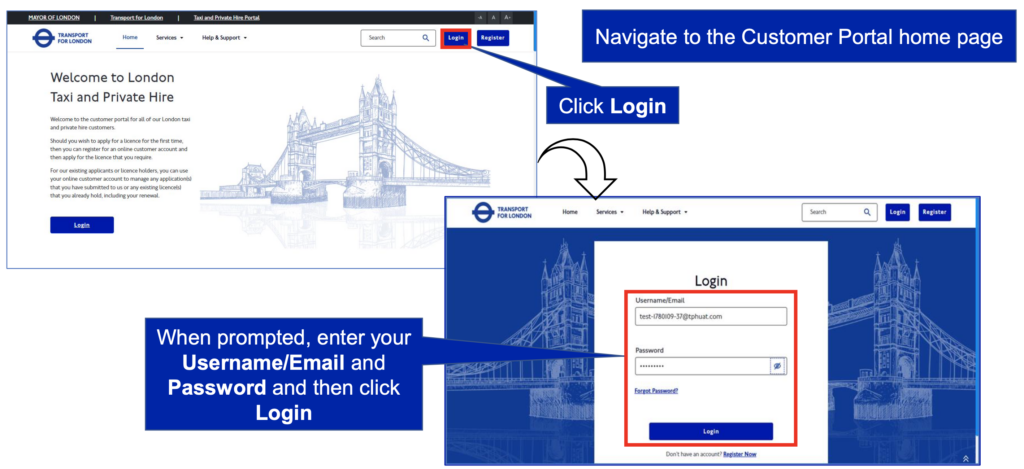
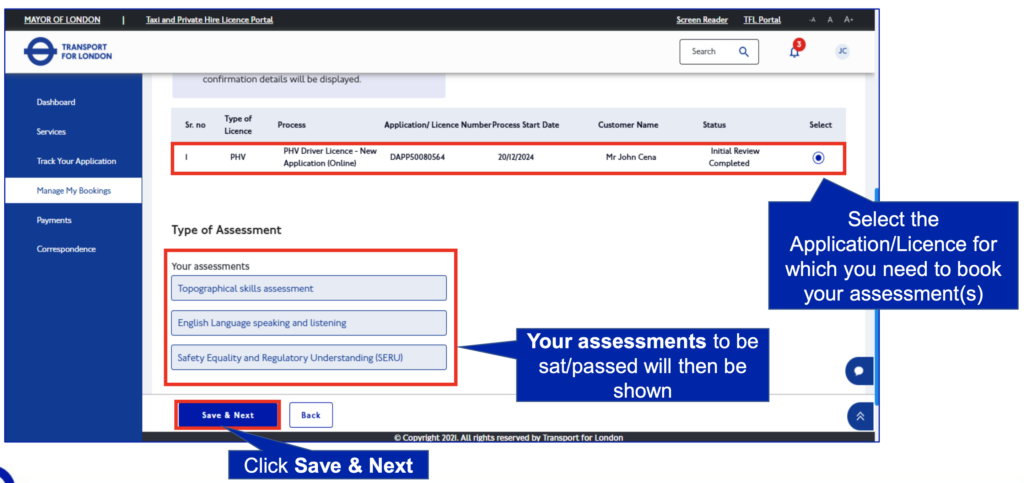
    Step 1. Login (click button on the top right)


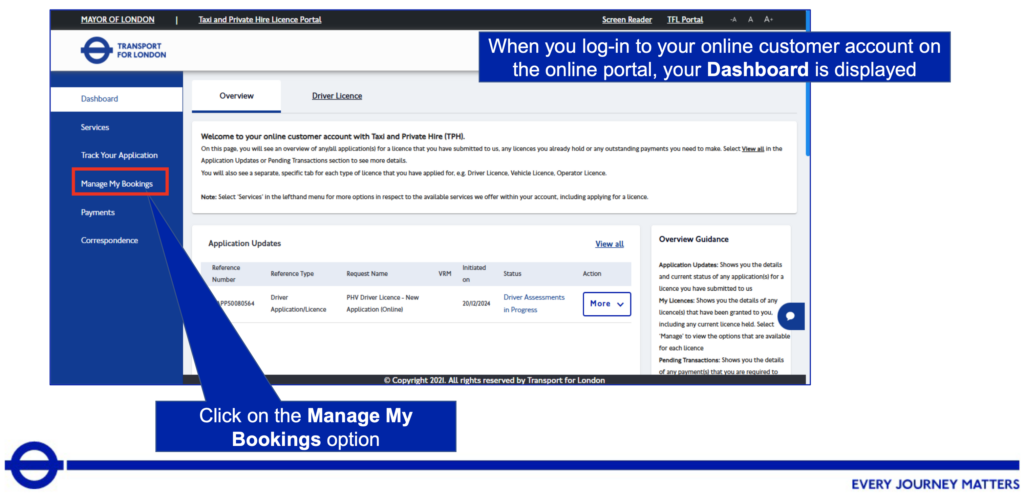
    Step 2. Select “Manage My Bookings” (from left menu)


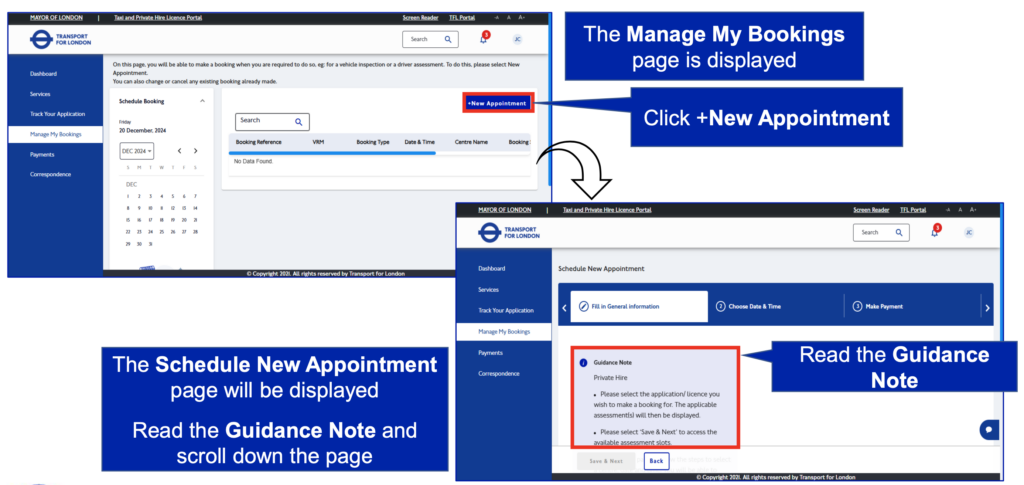
    Step 3. Click +New Appointment (button on top right)


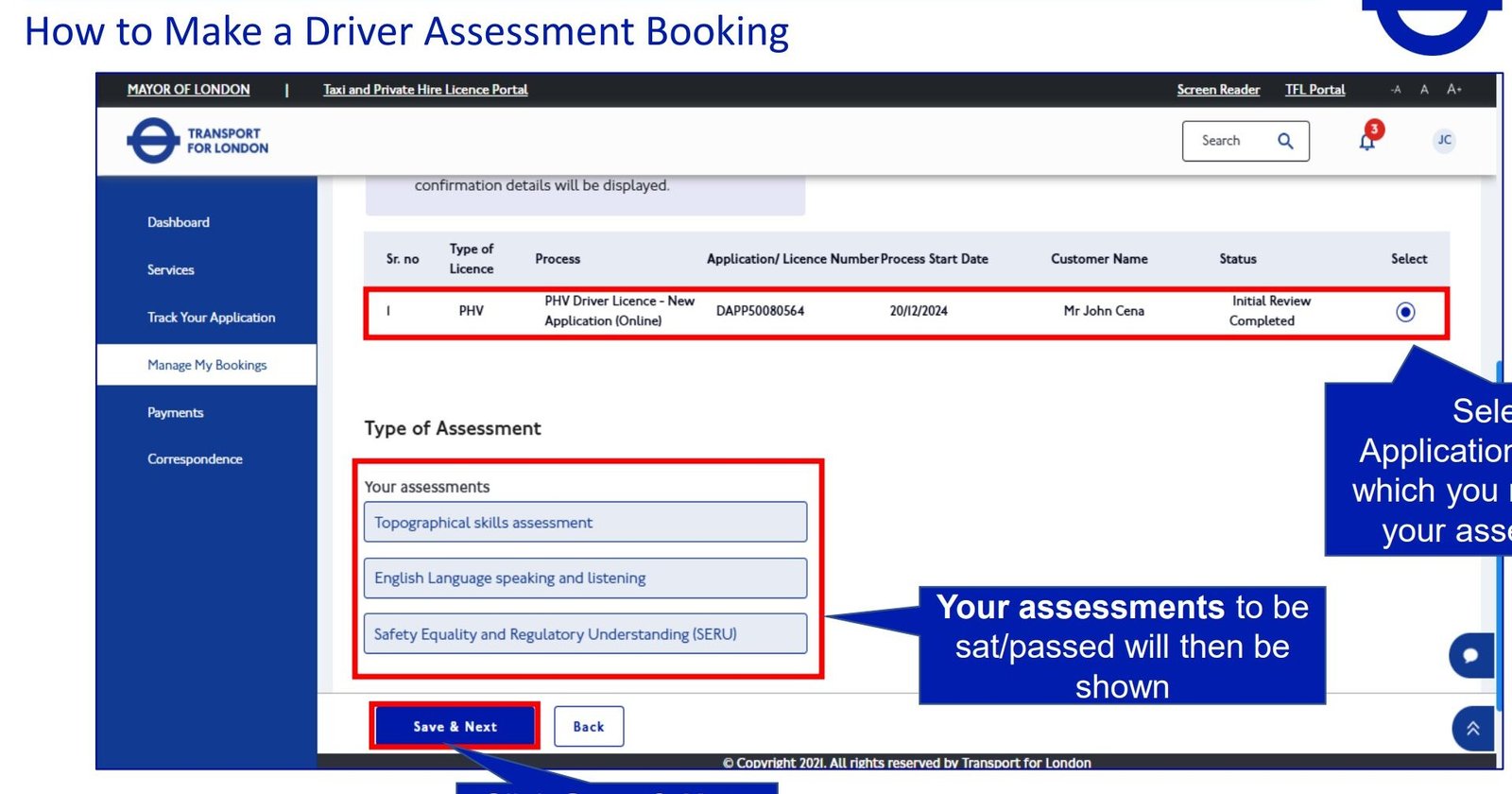
    Step 4. Make sure your application is selected. Click Save & Next.


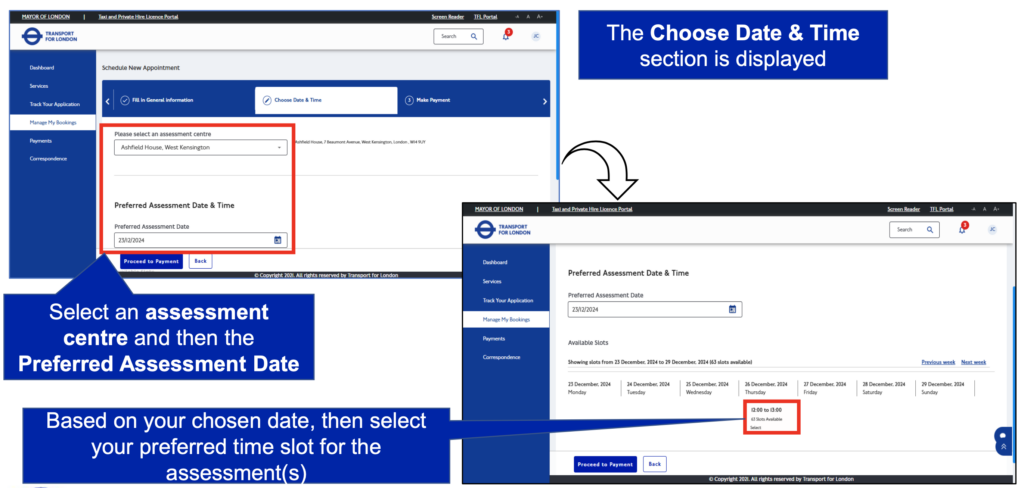
    Step 5. Select location and test dates


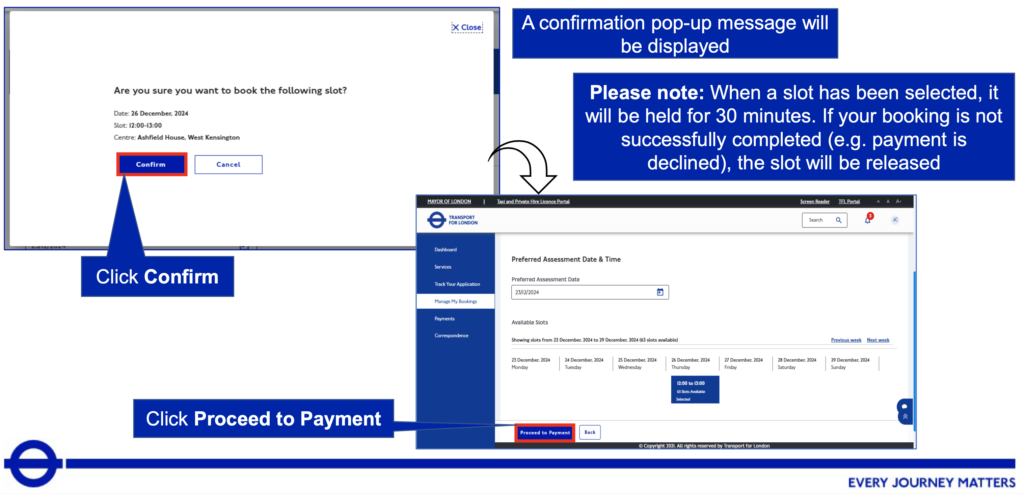
    Step 6. Confirm bookings


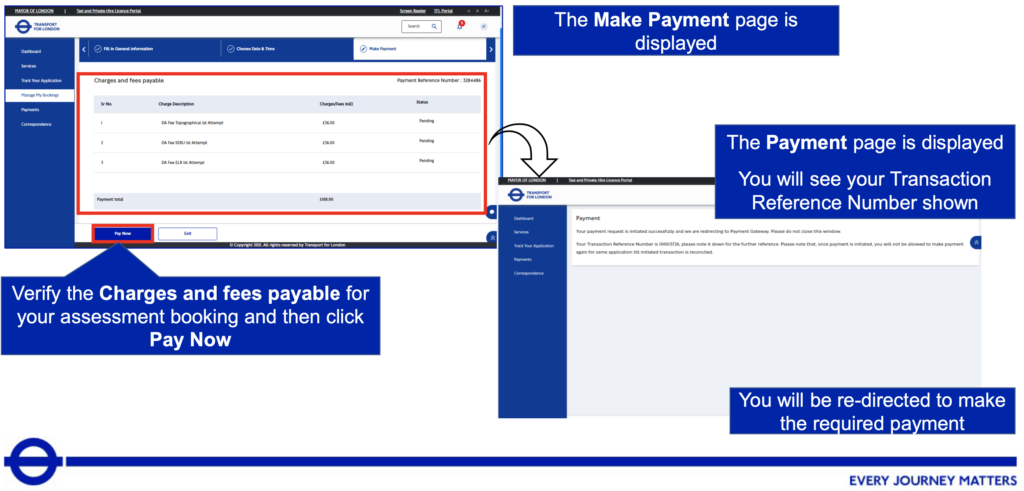
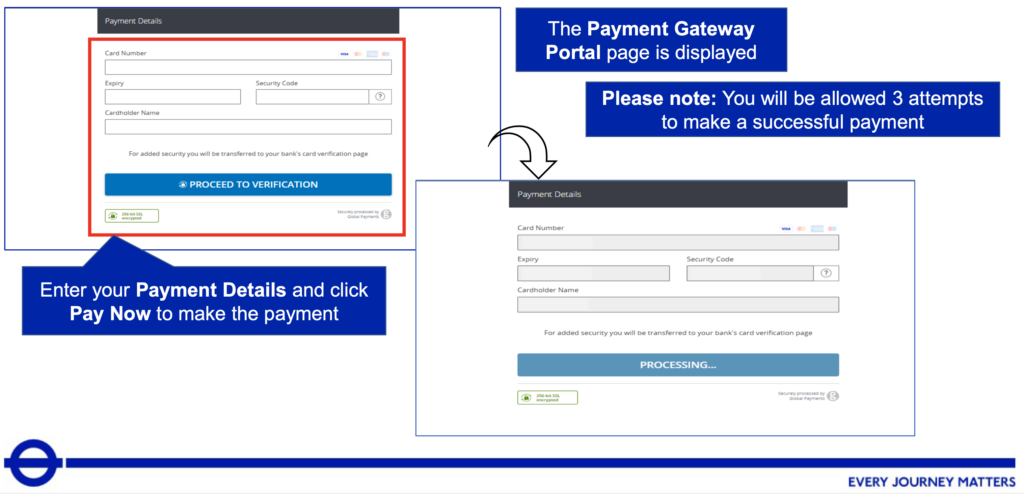
    Step 7. Click Pay Now (button bottom left)


    Step 8. Enter card details.


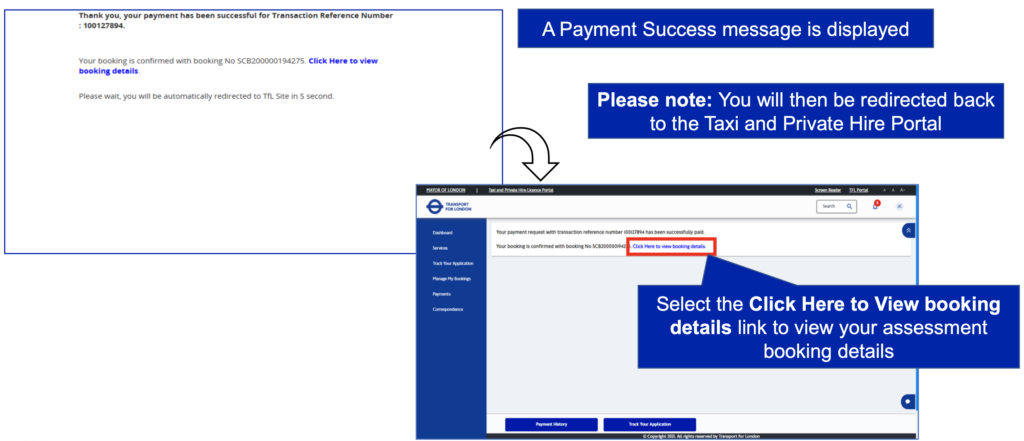
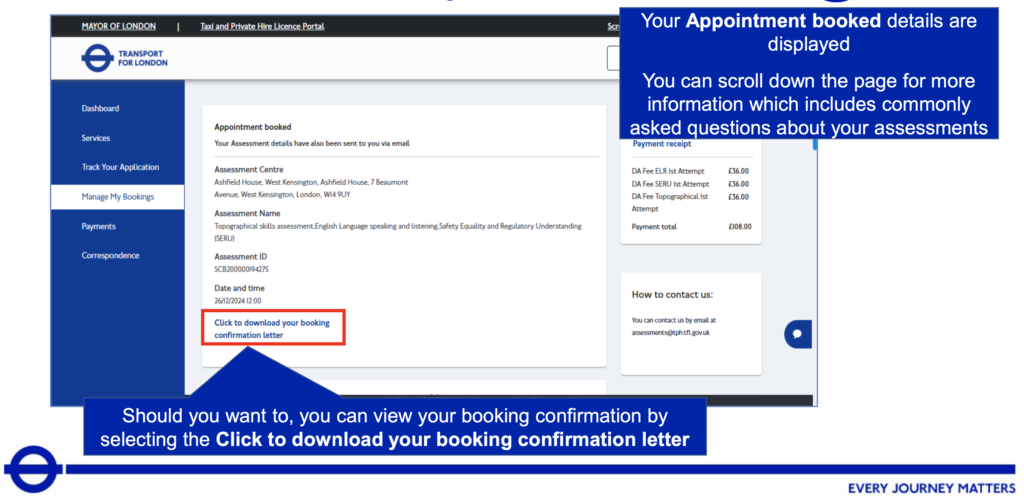
    Step 9. Booking confirmation page


    Step 10. Download your Booking confirmation letter

    * Please note, TfL must first invite you to book your tests.

    If you cannot see the option for booking a new appointment in the portal it means:

    • your application has not been reviewed yet (new applicants)or
    • you’ve not been invited yet to book your test

    You can contact TfL driver assessments booking on 03432224444 or support@tph.tfl.gov.uk

  • Tfl PHV Driver Handbook v1.

    Tfl PHV Driver Handbook v1.

    This is the most up to date version of the handbook, as of today,

    [wpdts-date]

    Download handbook

    Please note that the Handbook does not contain any questions or answers.

    You can find Official Format Tfl SERU questions here

    Handbook for PHV Drivers

    The PHV Driver’s Handbook serves as a practical guide for PHV drivers, offering invaluable assistance.

    The Handbook is subject to periodic review and may undergo alterations or amendments to align with any legal modifications or changes in TfL policies and guidance.

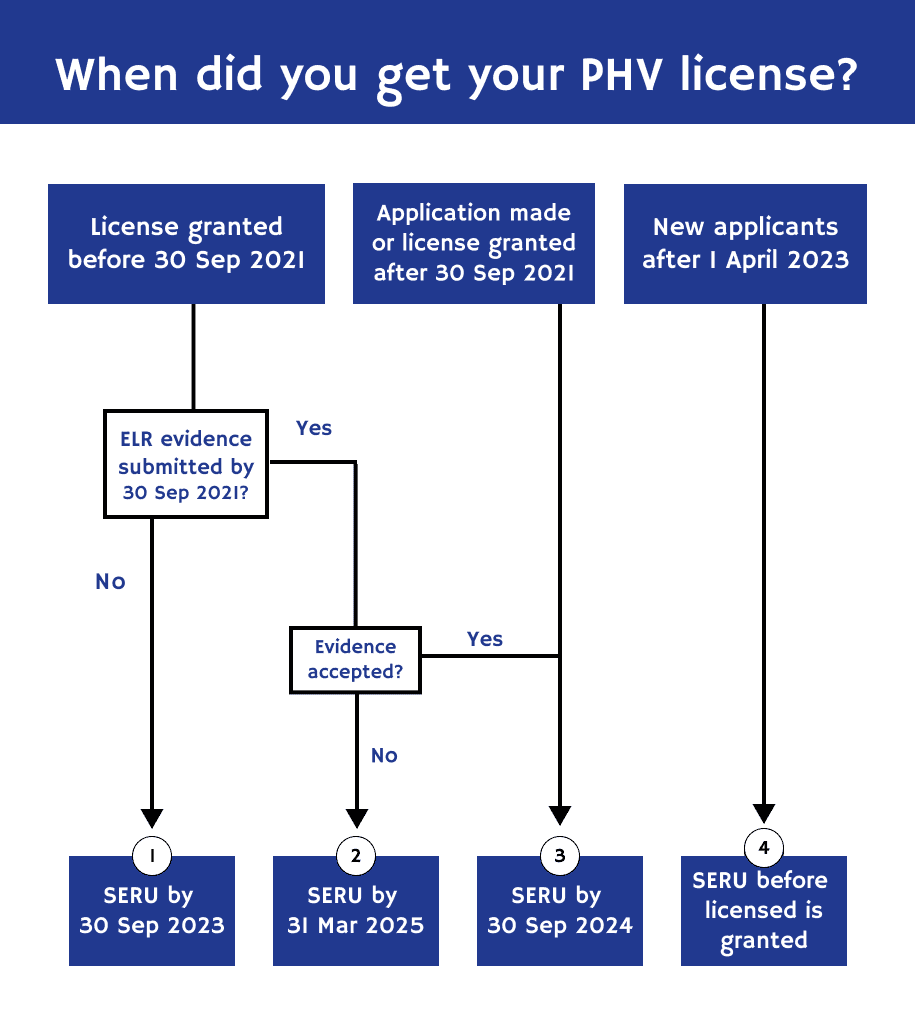
  • Has the TfL SERU Assessment been cancelled?

    Has the TfL SERU Assessment been cancelled?

    Following from TfL’s e-mail and Sadiq Khan’s announcement, some drivers are unsure about the update.

    We have put together this summary to clarify that, according to TfL:

    0. The SERU Assessment has not been scrapped / stopped.

    1. Group 1 PHV drivers will not lose their licence no matter how many times they fail (as long as they attend).

    2. If drivers don’t respond or attend their assessments, TfL may suspend or revoke their licences.

    3. TfL is trialling a new SERU style where drivers will have the handbook with them during the test.

    4. This trial will only be for some Group 1 drivers.

    5. If the trial is successful, TfL may apply this new style to all SERU assessments (after many months).

    6. All drivers must pass still pass the SERU assessment.

    Find out which group driver you are


    SERU-date-chart-FAQ-1.png (915×1019)

    www.serupractice.com

    020 3965 7202

    https://wa.me/+447418609836

  • Better PHV Driver Earnings: How to Maximize Tips

    Better PHV Driver Earnings: How to Maximize Tips

    Are you a rideshare driver seeking to optimize your earnings through tips? Although fares constitute the majority of your income, receiving substantial tips can significantly enhance your overall earnings. It’s disheartening to take home less money, especially after spending the entire day navigating the streets. But worry no more!

    By making a few adjustments to your driving behavior, you can attract a wealth of tips from your passengers. You’ll be amazed at how these tips can offset your routine car maintenance expenses, ultimately safeguarding your income.

    Let’s delve into some effective tactics for boosting tips for rideshare drivers, thereby elevating the profitability of your driving experience.

    1. Abandon Unfocused Driving

    Instead of driving aimlessly, prioritize taking the most direct route to the destination to eliminate unnecessary time wastage for both your passengers and yourself. Prompt pick-ups and speedy arrivals also reduce passenger waiting times.
    This contributes to a positive experience and underscores your professionalism. Steering clear of aimless driving demonstrates your respect for your passenger’s time and convenience.

    2. Acquaint Yourself with the Vicinity

    As a rideshare driver, having a thorough understanding of your operating area and acquainting yourself with its streets is pivotal. Familiarity with bustling streets, shortcuts, and landmarks is a crucial strategy for increasing tips, allowing you to select quicker routes. This also translates to higher earnings by completing more trips in less time.
    Mastery of the city landscape also enables you to identify high-demand zones during various times of the day.

    Utilize maps and navigation apps to enhance your knowledge. Establish connections with fellow rideshare drivers for insights into optimal routes and pick-up locations. Engaging passengers in conversation can yield valuable recommendations. These efforts culminate in a pleasant ride experience, often resulting in generous tips.

    3. Maintain a Pristine Car

    A clean environment significantly influences tip accumulation—this principle applies universally. Similarly, maintaining a neat and tidy vehicle is crucial for rideshare driving. Both the car’s interior and exterior should be immaculate. Regularly washing the car’s exterior and cleaning the interior daily are essential steps.
    Prioritize the cleanliness of your seats, ensuring they are devoid of unpleasant odors. Utilizing air fresheners or essential oils can impart a pleasant fragrance to the car’s interior.

    Personal hygiene is equally important. Daily showers and wearing well-maintained, wrinkle-free attire elevate your appearance, exuding confidence and professionalism, ultimately boosting your tip prospects.

    4. Multi-App Driving

    Broaden your earnings potential by registering with multiple ridesharing apps. This approach expands your customer base and augments ride requests. With more opportunities to pick up passengers, your earning potential escalates.
    Additionally, this strategy affords you flexibility in selecting when and where to drive. If one rideshare app experiences low demand, you can switch to another. This also proves beneficial during technical glitches or temporary account suspensions.

    Embracing this approach enables you to cultivate a diverse customer network, a practice prevalent among drivers nowadays.

    5. Engage in a Community

    Other rideshare drivers aren’t just competitors; they serve as invaluable sources of shared experiences, tips, and strategies. Online communities can be found through various forums and social media groups.
    Leverage these platforms to connect with the driver community. Beyond providing driving tips and strategies, these communities keep you updated on industry trends and local events.

    That said, integrating these tips enhances passenger experience, thereby increasing the likelihood of receiving gratuities.

    6. Foster Friendliness

    A friendly demeanor never goes unnoticed. It ranks among the most potent strategies for amassing tips. A cheerful and optimistic attitude can significantly influence your passengers.
    Greet your passengers with a warm smile and maintain a friendly dialogue throughout the journey. Strive to connect with passengers, cultivating a welcoming ambiance.

    Express genuine interest in your passengers’ well-being, offer assistance when needed, and actively listen to them. While being amicable, uphold your personal boundaries as a rideshare driver.

    Implement these recommendations and witness the transformative effects.

    7. Offer Compliments

    Complimenting passengers can wield considerable influence in augmenting your tips as a rideshare driver. Compliments possess the power to uplift moods swiftly. Acknowledging or appreciating something about your passengers can substantially improve their mood.
    Simple statements like “Your perfume’s fragrance is delightful” can go a long way. Such compliments signify your appreciation and recognition of your passengers’ presence.

    Furthermore, these compliments initiate amiable conversations, bolstering passengers’ confidence and potentially encouraging more generous tipping.

    8. Avoid Hasty Driving

    It’s crucial not to rush through rides in an attempt to maximize your earnings per hour by hurrying passengers to their destinations. Such haste can compromise safety, leading to traffic violations and potentially backfiring.
    Furthermore, rushing passengers might leave them feeling dissatisfied. Prioritize a comfortable, smooth journey that reflects professionalism. Reckless driving only results in lower ratings, negative reviews, and an adverse impact on your tips.

    9. Personalize with Names

    Calling passengers by their names might seem minor, but it holds significant effectiveness. It’s a gesture of respect, showcasing the importance you place on them.
    Although directly addressing customers by their names might feel awkward, utilizing titles like Mr. or Mrs. along with their names is a suitable alternative.

    As passengers exit, express gratitude using their names. This courteous act substantially increases the likelihood of receiving a tip.

    10. Capitalize on Peak Hours

    Leverage peak hours and surge driving to enhance your earnings. Rideshare platforms like Uber offer surge driving incentives, motivating drivers to be available in high-demand zones. Surge pricing increases fares, thereby boosting your income.
    Stay informed about areas with high demand and align your driving towards these locations during peak hours. Busy shopping districts, airports, and downtown areas offer greater ride potential and, consequently, more substantial tips.

    11. Harness Social Media for Promotion

    Utilizing social media for self-promotion is a powerful tactic to amplify your earnings. The vast global audience of 4.4 billion people on social media makes it easy to reach thousands with your content.
    Creating engaging content, sharing driving insights, and providing guidance to new drivers can attract attention. Incorporating humor into your videos can further draw interest to your profile.

    This approach encourages potential passengers to consider using your services, and familiarity from social media interactions may result in more generous tipping.

    12. Employ Subtle Tip Reminders

    Tastefully reminding passengers about tipping can be done through unobtrusive messages placed visibly in your car. Adding a touch of humor can brighten your passengers’ day while reinforcing the tip notion.
    Consider these options:

    Craft handwritten thank-you notes with a mention of tips being appreciated.
    Display a slide on your in-car tablet that gently reminds passengers about tipping.
    Attach tip cards to the back of your seats.
    Create a tip jar with an attached sign or sticker, placed in a visible location.
    Exercise respect when implementing these reminders, and ensure alignment with rideshare company policies to maintain a positive platform relationship.

    13. Enhance Ride Comfort

    Optimizing the passenger experience is vital to boosting tip potential. Ensuring a comfortable ride significantly contributes to garnering more tips.
    Maintain a pleasant temperature inside the car, adapting to weather conditions.
    Utilize heating or air conditioning as necessary.
    Adjust seating arrangements for passenger comfort.
    Consider playing soothing background music, making sure it’s appropriate.
    Providing a comfortable journey is a universal passenger expectation. Meeting this demand often results in passengers being more inclined to tip generously.

    14. Personalize the Ride

    Apart from ensuring comfort, tailoring the ride to individual passengers is key to leaving them content and satisfied. This personalized approach tends to correlate with higher tip likelihood.
    Extend a warm greeting to passengers, making them feel valued.
    Offer amenities such as water and phone chargers for added convenience.
    Suggest local attractions, especially for tourists.
    Gauge passenger preferences for conversation or a quiet ride.
    Adapt the route based on passenger preferences, avoiding certain roads or opting for scenic routes.

    15. Leverage Technology for Assistance

    Employing technology enhances the customer experience, a primary goal for rideshare drivers. Accept digital payments to streamline transactions and simplify tipping for customers. GPS systems and navigation apps aid in delivering a seamless ride experience, while rating reminders and personalized app features encourage passengers to tip.

    16. Avoid Unsafe Routes

    Prioritize safety for both yourself and passengers by carefully planning routes to avoid unsafe areas. Conduct research to identify areas with higher crime rates, and opt for reliable navigation apps that provide real-time traffic updates.

    Additionally, respecting reasonable route requests from passengers enhances their trust. By following these strategies, you ensure a positive passenger experience, ultimately increasing your chances of receiving tips.

    Concluding Thoughts!

    Increasing your earnings through generous tips from passengers doesn’t have to be complicated. The key lies in providing a clean, positive, and comfortable ride that enhances the overall experience for passengers.

    Don’t limit yourself to a single ridesharing app, as diversifying across multiple platforms can substantially boost your income. It’s not about acquiring special skills; rather, it’s about being organized and implementing effective strategies to achieve success in this endeavor. So, get started and enjoy the benefits of these straightforward approaches!